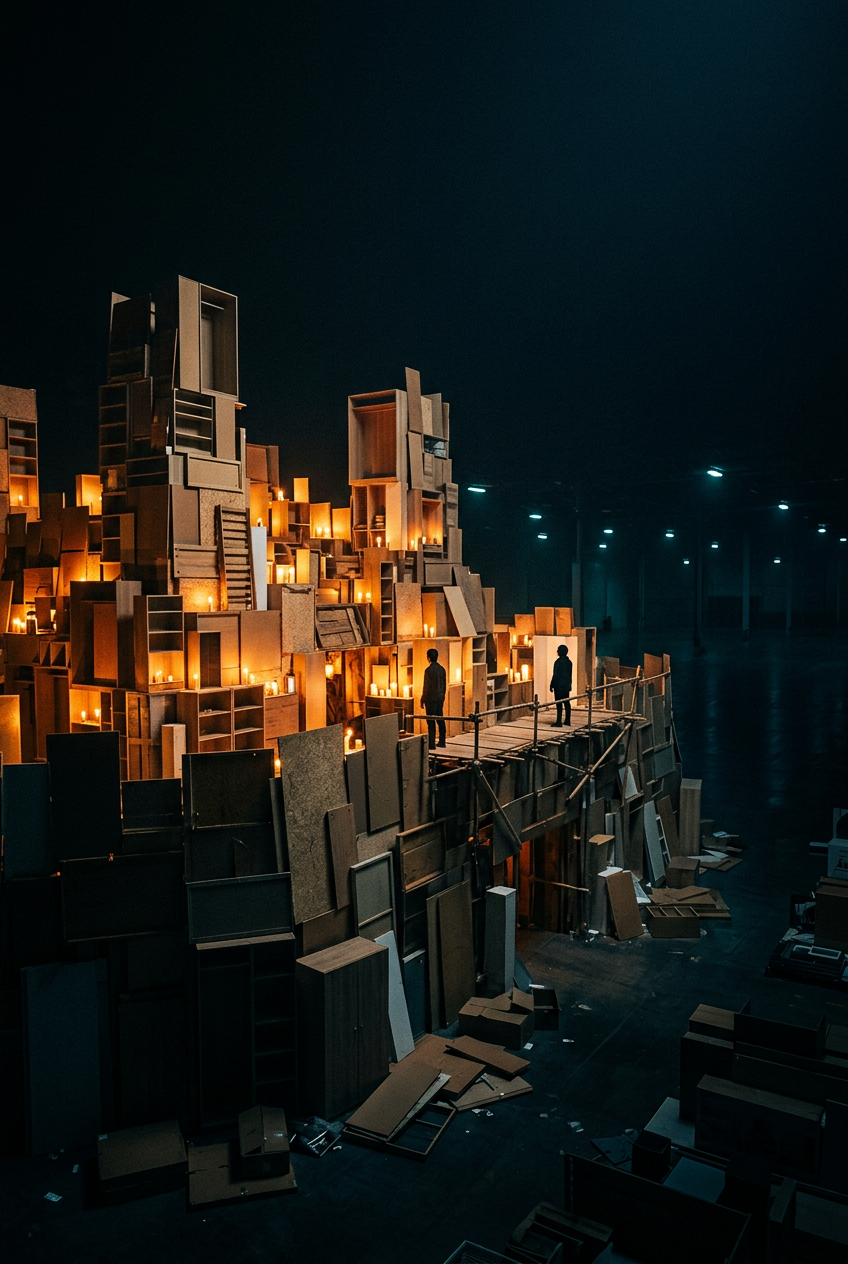
INT. BEDROOM SHOWROOM - DAY
The bedroom is a BRIMNES configuration. White laminate headboard, two matching nightstands, a MALM dresser with the drawer pulls aligned at precise intervals. A RIBBA frame on the wall holds a stock photograph of a woman laughing at something outside the frame. The overhead fluorescents throw no shadows. Everything is the color of institutional calm.
ALAN is on his hands and knees at the baseboard, counting under his breath. He holds a yellow pencil stub between two fingers like a conductor's baton. His notebook is open on the floor beside him, a grid of measurements accumulating in columns so small and regular they look typeset. He reaches the corner, marks a number, and begins the return pass along the adjacent wall without standing up.
SOREN sits on the edge of the bed. He has the posture of a man who has chosen to be comfortable. His hands rest on his knees. He watches Alan with the patient attention of someone watching a familiar kind of weather.
Alan reaches a point three feet from the door, stops, and looks at the notebook. He looks at the wall. He goes back to the baseboard and counts from the corner again, moving his lips.
SOREN
There's a POÄNG in the living room set, if you'd rather have a chair.
Alan does not look up.
ALAN
Eighty-one and a half.
SOREN
The POÄNG is quite good for the back. I've found that.
ALAN
It was eighty-four yesterday.
A pause in which Soren turns this over without alarm.
SOREN
Yes, it does that sometimes.
ALAN
Concrete doesn't settle in twenty-four hours.
SOREN
I don't think it's settling. I think that's just the room.
Alan sits back on his heels. He looks at the wall the way he would look at a load-bearing calculation that has produced a negative number. Then he opens the notebook to the previous day's column and holds it against the current column, index finger tracking across both.
The PA chime sounds. It is a two-note tone, major third, ascending. Then a voice. The voice is unhurried and without regional accent, the voice of someone reading a prepared statement to an audience they will never meet.
Good morning. The IKEA Family store is now open. Today's featured room setting is the HEMNES bedroom collection, located in Showroom Sector Four. Children's play areas are fully staffed. The restaurant opens at nine thirty. We hope you enjoy your visit.
Alan's pencil has stopped moving. He is looking at the PA speaker grille mounted in the upper corner of the room. A small rectangle of perforated metal, no larger than a paperback book. He watches it for a moment after the voice has finished, as if it might continue.
Then he goes back to the baseboard.
ALAN
What time does the morning announcement run.
SOREN
When the morning is. More or less.
ALAN
I need an hour estimate.
SOREN
I stopped keeping those. You'll find it's less wearing.
Alan writes something. He moves to the third wall, presses his palm flat against the laminate, and begins counting from the corner again. His lips move. He reaches the far edge, checks the notebook, and a very small stillness enters his body.
SOREN
What.
ALAN
The perimeter doesn't close.
SOREN
Doesn't close.
ALAN
A closed rectangle — four walls, you measure all four, the opposing pairs are equal, the total perimeter is consistent. This room's perimeter is not consistent. The numbers from the four walls do not produce a rectangle.
Soren looks at the room. The room looks back. It is very clean. The RIBBA photograph catches the flat fluorescent light and the laughing woman in it seems slightly overexposed, her face blown toward white.
SOREN
I suppose that's true of it, yes.
ALAN
The room was designed to the millimeter. Every component in here was manufactured to tolerance. The tolerances are published. I've looked at them.
SOREN
Where.
A pause.
ALAN
I looked at them. Before.
He does not elaborate on before. The word sits in the room like an object someone has set down and not picked up.
Soren smooths the duvet with one hand. The duvet is a GULSPARV, white with a thin grey stripe. He does the smoothing with the automatic care of someone who has made this bed many times.
SOREN
You know what I've come to think is genuinely remarkable about these rooms.
Alan is writing.
SOREN (CONT'D)
They got the proportions right. Not the dimensions — the proportions. The ratio of ceiling height to floor area. The way the bed sits relative to the window. There's no window, obviously, but the wall where a window would be — they left it lighter. A slightly warmer panel. You can feel it if you stand there.
Alan stands. He crosses to the wall Soren has indicated. He puts his palm against it. He stands there for three seconds.
ALAN
Same temperature as the others.
SOREN
I said feel, not measure.
Alan takes his hand off the wall. He looks at the notebook. He looks at the four walls in sequence, moving his gaze around the room like a man checking corners. Nothing moves. The RIBBA photograph. The MALM dresser. The nightstand with its single JANSJÖ lamp, switched off, plugged into nothing.
He opens the notebook to the inside front cover. There is a sketch there, pencil, worked over many times — a woman's face, three-quarter view, the lines going soft in places where the pencil has been pressed and re-pressed. He looks at it for a moment with the focused attention he gives the measurements. Then he closes the notebook.
SOREN
Someone you knew.
ALAN
Yes.
SOREN
It's a good likeness.
ALAN
You've never seen her.
SOREN
No. But it looks like a good likeness. The way you've done the eyes.
Alan puts the notebook in his jacket pocket. He picks up the yellow pencil from the floor and rolls it between his fingers once, a small rotation, and puts it in his breast pocket.
ALAN
The wall is three inches shorter than yesterday. That's not measurement error. Three inches is not a rounding problem.
SOREN
I know it feels that way.
ALAN
It doesn't feel like anything. It's a number. The number is different.
Soren looks at him with something that is not quite pity and not quite recognition, something between them that has no clean name. He pats the duvet again, one flat-palmed stroke.
SOREN
Come and have something to eat. The meatballs were restocked last Tuesday. They're quite decent.
Alan stands in the middle of the room. He looks at the four walls. He looks at the PA speaker grille. He looks at the RIBBA frame, the laughing woman going white in the fluorescent wash.
He does not move toward the door.
SOREN (CONT'D)
The numbers will still be wrong after breakfast.
Alan looks at the floor. He looks at the baseboard where the wall meets it, the clean white join, the laminate floor pressed exactly to the edge.
ALAN
I know.
He does not move.
Soren waits. He is very good at waiting. He has had a long time to get good at it.
Outside the showroom, somewhere in the middle distance of the store, a STAFF member passes the entrance without looking in. The proportions are slightly wrong — the arms a fraction too long, the neck carrying the head at an angle that suggests a different center of gravity. It moves without sound. It does not look in.
Neither of them mentions it.
Alan sits down at the small dining table positioned at the foot of the bed, a LISABO, two chairs, a faux succulent in a terracotta pot at the center. He opens the notebook again. He finds yesterday's measurements. He finds today's. He puts the yellow pencil to the page.
The pencil moves. The numbers accumulate. The faux succulent casts no shadow.
INT. EXCHANGE & RETURNS SETTLEMENT - DAY
The settlement occupies what was once the Exchange & Returns processing area — a wide, low-ceilinged space behind a service counter that has been stripped of its original function and filled, over time, with the accumulated furniture of people who stopped moving. KALLAX units form the outer walls, packed with salvaged goods. A HEMNES dresser serves as a filing cabinet. Extension cords run from a junction box near the ceiling in a pattern that suggests years of incremental addition. Everything is level. Everything is clean. This is not accident; this is policy.
MAEVE stands at the service counter, which she has converted into a standing desk. She is perhaps forty-five, though the fluorescent light makes age difficult. She holds a clipboard with a printed inventory form, handwritten additions in the margins in three different inks. DANI sits cross-legged on the counter beside her, sorting a pile of SAMLA boxes by size, her movements automatic, her attention slightly elsewhere.
Good morning. The time is ten forty-seven. Today's restocking includes the VARDAGEN cookware range, sections twelve through fourteen. Customers requiring assistance may locate a co-worker in any department. Thank you for shopping with us.
Neither of them reacts to the announcement. It is furniture.
MAEVE
The SAMLA lids. Stack them separate or they nest wrong and you lose a quarter of the volume.
DANI separates the lids without looking up. She is watching the entrance.
ALAN comes through the gap in the KALLAX wall — the settlement's main entrance, a space two units wide, the edges worn smooth from years of passage. He carries a rolled tube of drafting paper under one arm and a canvas bag over the other shoulder. He has been walking for some time; there is a specific kind of tiredness in him that comes from sustained attention rather than physical effort. He stops just inside the entrance and takes in the room with the systematic scan of someone who checks dimensions before anything else.
His eyes pass over Maeve's desk. There is a silver RIBBA frame on it, angled toward the visitor's side of the counter. A stock photo: a woman laughing, blonde, teeth very white, the background a seamless warm grey. For one moment — less than a second — something in Alan's face rearranges itself. He looks away before he has fully looked.
MAEVE does not look up from the clipboard.
MAEVE
You missed the six o'clock count.
ALAN
I was in sector nine.
MAEVE
I know where you were. Petra tracked you on the board.
She makes a notation. The pen moves with the efficiency of someone who has been making notations for a very long time.
MAEVE (CONT'D)
The count is not optional.
ALAN
I understand that.
He sets the canvas bag on the floor and unrolls the drafting paper on the counter's far end, anchoring one corner with his hand and the other with the canvas bag. The map is dense — a structural engineer's drawing, not a scavenger's sketch. Grid lines. Measured corridors. Annotated anomalies in a small, careful hand.
DANI leans slightly to see it. She does not lean far. She has learned to make her interest look like proximity.
MAEVE sets the clipboard down. She looks at the map. She looks at it the way someone looks at a thing they have already decided about. She does not touch it yet. She reads it from where she stands, her eyes moving along the grid lines with the same economy she brings to an inventory form.
MAEVE
How far.
ALAN
To the edge of what I can verify. Sector nine terminates at a corridor junction that doesn't appear on any of Petra's drawings. The junction runs north — or what I'm calling north — for at least forty meters before the fluorescents thin out.
MAEVE
Thin out.
ALAN
The fixture density drops. The spacing between overhead units increases by about a meter every four units. It's a gradient. It suggests the corridor continues past the maintenance threshold for the retail floor.
A pause. MAEVE looks at the map. She looks at it the way someone looks at a thing they have already decided about.
MAEVE
What are you asking for.
ALAN
I want to take the junction north. I need two days, a scavenger escort for the first leg, and access to whatever geographic data the settlement holds that isn't on Petra's drawings.
DANI has stopped sorting. The SAMLA lid in her hands has been still for thirty seconds. She is looking at the map.
MAEVE
Dani.
DANI
I'm listening.
MAEVE
The lids.
DANI resumes sorting. She does not look away from the map immediately. She takes a moment.
MAEVE picks up the clipboard again. She does not look at Alan.
MAEVE
The east wall of the sleeping quarter took a stress fracture last night. Third panel from the entrance. The KALLAX unit is load-bearing at that point and the bracket system is failing.
ALAN
I can look at that this afternoon.
MAEVE
You'll look at it this morning.
ALAN
The junction —
MAEVE
Is forty meters of corridor with bad lighting. It will be there tomorrow.
She writes something on the clipboard. The pen moves with finality.
ALAN
You have data I don't have.
The pen stops. MAEVE looks up. It is the first time she has looked directly at him since he entered.
MAEVE
In the second leadership period, we had a mapper. Good one. Spent eight days running a corridor system in the northeast quadrant, built out a survey that covered ground none of us had touched. On day nine she went back to verify a junction she'd marked as uncertain. We found her three weeks later, two sectors over, no water, no light source. The survey died with her because no one else had the context to read it. What I have that you don't is the knowledge of what an unverified junction costs when the person who mapped it doesn't come back.
ALAN
I mean geographic data. Structural surveys. There were people here before Petra who mapped. Soren told me the settlement has existed through at least four distinct leadership periods. That's years of accumulated —
MAEVE
Soren talks a great deal.
ALAN
He said the records exist.
MAEVE
Some records exist.
A beat. Alan waits. He has learned, in the time since he arrived, that Maeve fills silences on her own schedule.
MAEVE (CONT'D)
The settlement's function is to keep the people in it alive through the night. That is the only function. Everything we build, everything we map, everything we reinforce — it serves that. When it stops serving that, it stops being a priority.
ALAN
Knowing the store's geometry serves that. If there's a structural boundary — an actual perimeter —
MAEVE
There isn't.
The flatness of it. Not dismissive. Certain.
ALAN
You don't know that.
MAEVE
I know what happens to people who go looking for one. I know what they look like when they come back, and I know what they look like when they don't.
She sets the clipboard down again. She moves to the end of the counter and picks up Alan's map by the corner, not roughly, but without asking. She looks at it the way she looked at it before — with the attention of someone reading something they have already read.
ALAN
That's —
MAEVE
Your work is good. The grid methodology is sound. The anomaly notation is useful.
She rolls the map. She does it neatly, respecting the paper.
ALAN
I need that back.
MAEVE
You'll get it back when the east wall is assessed and the bracket system is documented. That's two hours. Maybe three.
She opens the HEMNES dresser behind the counter. The bottom drawer — the one with the small barrel lock. She places the rolled map inside. She turns the key. She puts the key in her front pocket. She closes the drawer. She picks up her clipboard.
MAEVE (CONT'D)
Petra will show you the wall. She knows the bracket system.
ALAN
And after the wall.
MAEVE
After the wall, we'll talk about what the settlement needs next.
ALAN
That isn't an answer.
MAEVE
It's the answer I have.
She turns back to the inventory form. The conversation, by her accounting, is over. DANI is watching Alan. She is holding a SAMLA lid in both hands, perfectly still, her expression doing something careful and internal that she has not yet learned to fully conceal.
Alan stands at the counter. He looks at the HEMNES dresser. He looks at it for a half-second too long before he turns and walks toward the east wall.
The fluorescent light comes down on all of them from directly above, flat and even and without shadow, and the HEMNES drawer is closed, and the map is inside it.
DANI is watching Maeve.
MAEVE
The SAMLA lids.
DANI looks down at the lid in her hands. She puts it on the correct stack.
The fluorescent light does not change. It is not capable of changing. It comes down from above, flat and institutional, the same at ten forty-seven as it will be at any other time the PA chooses to name.
INT. KITCHEN SECTOR - DAY
The kitchen sector runs in long parallel rows — SEKTION frames bolted to the floor in configurations that suggest showrooms but have lost their original logic. Cabinet doors stand open at irregular intervals. Some hold supplies. Some hold nothing. Some hold darkness that does not resolve when you look directly into it.
ALAN moves ahead of the other two, one hand trailing the edge of a HÄLLESTAD countertop. He is counting his steps. He has been counting since they entered the sector.
PETRA follows three paces back, a canvas FRAKTA bag over each shoulder. Her eyes move in a pattern — left wall, right wall, the gap between two SEKTION islands ahead — and the pattern is automatic, the way breathing is automatic.
DANI brings up the rear. She is carrying a RÅSKOG cart, the kind meant for bathroom storage, loaded with empty SAMLA containers. The wheels catch on the floor seams. She corrects for it without looking down.
The overhead fluorescents run in a long unbroken line above the central aisle, then stop. Past the stopping point the next row of fixtures begins four meters further than it should. The gap is filled with a slightly different quality of light — not darker, exactly, but less resolved.
ALAN stops. He makes a notation in a small Moleskine, the kind sold in the stationery section three sectors back. He writes: fixture gap, 4m approx, junction with SEKTION row 7. He writes the step count.
PETRA
You're slowing us down.
ALAN
I'm documenting the fixture gap.
PETRA
I know about the fixture gap.
ALAN
Is it on your drawings?
A pause that is its own answer.
PETRA
We're here for GRUNDVATTNET and whatever canned goods made it into the bottom cabinets before the last restock. That's the run.
She moves past him, shouldering through the gap between two islands. The FRAKTA bags shift with the practiced weight of someone who has done this particular walk enough times that her body has made a groove in the air.
DANI pulls the RÅSKOG cart through the same gap. One wheel catches on a floor seam. She lifts the cart over it cleanly.
ALAN follows.
The next row of SEKTION units is configured as a galley kitchen — two runs of base cabinets facing each other across a narrow work corridor, overhead units closing the space from above. The effect is of a tunnel that someone has tried to make domestic.
PETRA moves to the left run and begins opening base cabinet doors in sequence. The first: empty. The second: three GRUNDVATTNET bottles on their sides, labels facing up. She loads them into the FRAKTA bag with the efficiency of someone who does not think about what she is doing while she does it.
ALAN opens the right run. First cabinet: a set of IKEA 365+ containers, lids separate. He stacks them into a SAMLA box on the RÅSKOG cart.
DANI opens the cabinet at the far end of the left run.
She does not move.
PETRA
What.
DANI
There's someone in here.
PETRA is at the cabinet in four steps. She looks in.
A person is folded into the base cabinet — knees to chest, back against the cabinet wall, head tilted at the angle of someone who has been unconscious or very nearly so. Adult, indeterminate age, wearing clothes that are wrong for the store in the way that new arrivals' clothes are always wrong — too specific, too outside. A jacket with a logo on the breast pocket. Shoes with actual mud on the soles.
The mud is the worst detail. It comes from somewhere.
PETRA
Shut the door.
ALAN
Excuse me.
PETRA
They've been in there long enough to stop moving. That's not a retrieval. That's a decision someone already made.
DANI
They're breathing.
PETRA
I can see that.
DANI
Then —
PETRA
We have six hours before the evening count and we're four sectors from the settlement. The RÅSKOG cart takes two hands. The bags take two hands. If she can't walk on her own that's a full carry for four sectors, which means nobody in this group has a free hand for the last two of them — and you and I both know what sector six looks like when the lights start their cycle. We'd be moving slow, loaded, and blind on one side.
She does not look at Alan when she says the last part. She does not need to.
ALAN crouches beside the cabinet. He looks at the person inside. He notes: the jacket, the mud, the way the hands are folded against the knees, the fact that the eyes are moving under closed lids. He notes the breathing rate, which is shallow but regular.
He notes that there is no way this person was here when the team entered the galley row. The cabinet door was closed. He opened it. He did not open it from the inside.
He does not write any of this down.
ALAN
What's their name.
PETRA
We don't know their name.
ALAN
Has anyone asked.
PETRA
They're not conscious enough to —
DANI
Hey.
Dani says it quietly, the way you say something to a person who is almost asleep. She crouches next to Alan. She puts one hand on the person's forearm — not gripping, just present.
The person's eyes open. They are not focused. They move across the ceiling of the cabinet, across the faces crouching in front of them, across the fluorescent light visible past the cabinet door, and they do not settle.
DANI
You're okay. You're — it's okay. Can you hear me?
The person's mouth moves. No sound comes out.
DANI
We're going to take you somewhere. There are other people. It's — you'll be able to sit down properly.
PETRA
Dani.
DANI
She's conscious.
PETRA
That's not the point.
ALAN
Then what is.
PETRA
The point is that we don't know how long she's been in that cabinet. We don't know what she's been through since she got here. We don't know if she can walk. We have the RÅSKOG cart and two bags and if she can't walk we're carrying her four sectors and that's four sectors where no one has a free hand.
She stops. She is looking at the person in the cabinet, and something in her face does it — not softens, exactly, but recalibrates. The way a load-bearing calculation recalibrates when you change one variable.
PETRA (CONT'D)
You want to carry her, you carry her. But when we hit sector six and she's dead weight and the lights are starting their cycle, you remember I told you exactly what that would cost us.
ALAN
I'll take the front carry.
PETRA
You don't know the route.
ALAN
Then you lead and I carry.
A long pause. Petra looks at the two FRAKTA bags. She looks at the RÅSKOG cart. She does the arithmetic of it — visible, in the small movements of her jaw.
PETRA
The cart stays. We can't manage the cart and a carry.
DANI
The SAMLA containers —
PETRA
Stay. We come back for them. Maybe.
She sets one of the FRAKTA bags down on the countertop and begins redistributing the GRUNDVATTNET bottles into the remaining bag, loading it to its functional maximum.
DANI helps the person out of the cabinet. The person can stand, barely, with Dani's shoulder under one arm. Her legs are working but not reliably.
Alan positions himself on the other side. He adjusts his grip — forearm across the back, hand on the far shoulder, weight distributed. Structural logic applied to a different kind of load.
They begin to move.
The return route runs north through the galley row, then east through a sector of KALLAX shelving units that have been loaded with display items — fake plants, FEJKA succulents in identical terracotta pots, a row of RIBBA frames each containing the same stock photo of a coastline. The photo shows water and sky. The sky in it is a specific color.
Good afternoon, IKEA family. The time is now two fifteen. Reminder that the Seasonal Living display in Hall C has been refreshed with our new SOMMARVIND collection. We hope you enjoy your visit.
They keep moving. The PA fades behind them the way all sounds fade in the longer aisles — not with distance, exactly, but with a quality of absorption, as though the shelving units take it in.
DANI's eyes move across the RIBBA frames as they pass. She looks at the coastline photograph. She looks at the sky in it.
She looks away. She does not ask.
The KALLAX sector ends at a junction. Three corridors. Alan has the junction on his mental map — he walked it this morning, step-counted it, noted the fixture density.
The junction now has four corridors.
He stops.
PETRA
What.
ALAN
This junction. This morning it had three exits.
PETRA
This morning you came from a different direction.
ALAN
I came from the east. I'm going to the east. Same corridor.
PETRA
Then you miscounted.
She does not look at him when she says it. She is looking at the four corridors, and her eyes are doing the same automatic pattern — left, right, gap — and the pattern does not hesitate. She has seen this before. She has seen it enough times that it has become part of the pattern.
PETRA (CONT'D)
Second from the left.
She moves into it. Alan follows, the survivor's weight shifting as they navigate the turn.
He looks back at the junction as they enter the corridor.
Three corridors.
He looks forward.
He does not write it down. His hands are full.
The survivor's breathing has steadied. She is taking more of her own weight now. Her eyes are open and tracking — moving across the KALLAX units on either side of the corridor, the FEJKA plants, the RIBBA frames, the fluorescent lights in their long institutional row.
She looks like someone reading a language she does not yet speak.
Alan recognizes the look.
They reach the sector boundary — a change in flooring from the kitchen sector's tile simulation to the settlement's familiar textile — and Petra stops.
PETRA
I'll go ahead and tell Maeve we're bringing someone in.
She means: I will tell Maeve before you do. She means: I will control what Maeve knows and in what order. She means something else too, underneath both of those things, but she does not say it and Alan does not say he heard it.
ALAN
Fine.
Petra goes. Her footsteps are even and unhurried, the footsteps of someone who has walked this particular distance many times.
DANI watches her go. Then she looks at the survivor, who is looking at the RIBBA frame on the nearest KALLAX unit. The coastline. The water. The sky.
The survivor makes a sound. Not a word. The sound of someone who has been holding something back and has just, very slightly, stopped.
Alan and Dani hold her up between them and walk the last corridor to the settlement entrance.
Behind them — in the kitchen sector, in the galley row, in the space where the RÅSKOG cart was left beside the cabinet — the cabinet door has closed.
The RÅSKOG cart is gone.
The floor seam where the wheel caught is there. The floor seam is always there.
The fluorescent light comes down on the empty galley row, flat and even, and the cabinet doors are all closed, and there is no indication that anyone was ever here, and the light is not capable of indicating anything.
Good evening, IKEA family. The time is now four forty-five. Our restaurant will be closing in fifteen minutes. We hope you've enjoyed your visit, and we look forward to seeing you again soon.
INT. EXCHANGE & RETURNS SETTLEMENT - NIGHT
The settlement's main space. KALLAX units form the perimeter walls, packed with salvage — canned goods, textile rolls, hardware sorted into SAMLA bins. The overhead fluorescents have shifted to the dim blue-grey of the store's night register. Shapes are legible. Faces are not.
In the near corner, three POÄNG chairs have been arranged around a low LACK table. SOREN sits in the central chair, a catalog open across his knees — the old kind, thick paper, the spine cracked from repeated handling. DANI sits to his left, her legs folded under her, watching his finger move down the page.
The overhead hum asserts itself in the quiet.
Soren does not look up from the catalog.
SOREN
Kitchen sections. That's where you start. Each room has a named configuration — METOD base units, AXSTAD fronts — and the configuration tells you which display generation you're in. Not approximately. Precisely. The way a date tells you which edition of a textbook you're holding.
He turns the page. His finger moves with the practiced efficiency of someone who has taught this before and knows which details students skip.
SOREN (CONT'D)
The bedroom sections will mislead you. The configurations repeat across too many generations — you'll think you've fixed your position and you'll be wrong. Living room sections are more reliable, but the kitchen is the foundation. Learn the kitchen nomenclature first. Everything else builds on it.
Dani traces the photograph on the open page with one finger. A kitchen. White cabinets. A window over the sink with light coming through it.
DANI
What's the light from.
SOREN
In the photograph.
DANI
Yes.
SOREN
Outside. They take the photographs in houses. Before.
Dani looks at the photograph another moment. Then she turns the page.
SOREN (CONT'D)
The bedroom catalogs are less reliable for navigation. The configurations repeat across too many display generations. But the living room sections —
He stops. He has noticed something across the room.
ALAN stands at the far wall, beside a low KALLAX unit that has been pushed against the service counter. He is not looking at the wall. He is looking at the stack of books on the shelf — not salvage stock, not SAMLA bins. Books. A dozen of them, spines outward. Textbooks, mostly. One with a cloth cover.
Soren watches Alan.
Alan pulls the cloth-covered book from the shelf.
SOREN
That shelf isn't for general use.
Alan opens the book. It is a secondary school atlas, the kind with political maps and physical maps and a section of blank pages at the back for student exercises. The blank pages are not blank.
He tilts the book toward the nearest fluorescent strip.
The pages are covered in pencil. Not handwriting — lines. A floor plan, drawn in the precise, patient style of someone who has been doing it for years, in a book small enough to hide. The scale is different from Petra's drawings. Smaller coverage, finer detail. The near sectors, rendered with a different methodology.
And at the upper margin of the last page, in handwriting that is not Soren's — smaller, more urgent, the pencil pressed harder — a notation.
Alan reads it. He reads it again.
He does not move for a moment.
Soren has closed the catalog. Dani looks between them.
SOREN
Put it back.
ALAN
There's a notation here. Upper margin, last exercise page. It gives a sector reference. A corridor designation I haven't seen on any drawing.
SOREN
I know the book.
ALAN
Then you know what it says.
SOREN
Put it back.
ALAN
Who made this drawing.
A pause. Soren looks at the closed catalog on the table. He does not answer immediately.
SOREN
A woman named Cressida. She was here before Maeve's time. Before my time, nearly.
ALAN
She left the book.
SOREN
She asked me to burn it. I told her I would.
He does not finish the sentence. He does not need to.
ALAN
The sector reference is consistent with the gradient I mapped in nine. The fixture spacing, the —
SOREN
Sit down.
Alan sits. Not in the POÄNG — on the edge of the LACK table, the book open across his knees, his thumb marking the page.
Dani has gone very still.
SOREN (CONT'D)
Cressida believed what she wrote. She went back to verify it. She was gone for eleven days. When she came back she had lost two toes to something she wouldn't describe and she sat in the chair you're sitting in now and she said she had found the same corridor again and it had been a different corridor.
ALAN
That could be disorientation. Exhaustion. If she was alone and sleep-deprived —
SOREN
She burned her drawings when she came back. All of them. Every page. She asked me to burn the book and I kept it, and I have been waiting for someone to find it ever since.
He stops. Something in his face settles into a shape that is not quite regret and not quite relief.
SOREN (CONT'D)
I'm not sure anymore whether I kept it because I thought it might be useful or because I wanted someone else to have to decide.
A long pause. The overhead hum. The blue-grey light pools in the angles of the KALLAX units and does not reach the floor evenly — it catches the top shelves and leaves the lower bins in a deeper shadow, so that the room appears to have a ceiling and no floor.
ALAN
What does the notation say.
SOREN
You've read it.
ALAN
I want to hear you say it.
Soren looks at him. The look is not hostile. It is the look of a man measuring what a piece of information will cost the person he gives it to.
He says nothing.
ALAN (CONT'D)
Soren.
SOREN
It says what it says. You've read it. You don't need me to confirm it.
ALAN
The corridor reference. The last line.
Another pause. Soren picks up the catalog from the table. Sets it down again, aligned with the edge.
SOREN
It says Exit Sector. It gives a corridor reference. It says the fluorescents stop.
Dani looks at the book.
The PA speaker grille above the service counter — a grey rectangle bolted to the wall, its mesh slightly oxidized — catches the blue-grey light and holds it.
Good evening, IKEA family. Our restaurant is now closed. Food Court Three will not reopen. We thank you for your patience and remind you that our co-workers are available to assist you throughout the store.
The three of them sit with this.
Not reopen. The phrasing is new. Alan registers it. He looks at the speaker grille. He looks back at the book.
SOREN
Give me the book.
ALAN
No.
SOREN
It needs to be burned. Cressida asked me to burn it and she was right to ask and I was wrong to keep it. Every time someone finds that notation they lose something they don't get back. You've already lost it. I can see that. But Dani —
He stops himself.
DANI
Finish it.
Soren looks at her.
SOREN
You have a life here. A real one. You have duties and people who depend on the work you do, and that is not —
DANI
I know what I have here.
The quality of her stillness has changed. She is not looking at the book anymore. She is looking at the middle distance, at something that is not in the room. The way she says it is not a defense. It is a statement of inventory. She has already counted what she has here, and she has already counted what the notation means, and she is not confused about the difference.
Soren looks at her. He looks at her the way he looked at the catalog photograph — with the particular attention of someone measuring a distance he cannot cross.
SOREN
Alan. Please.
Alan closes the book. He holds it.
He looks at Soren — at the man who gave him food when he arrived, who showed him where to sleep, who has been here long enough that the store has become the shape of his thinking — and he measures what he is about to do against what it will cost.
He stands up.
SOREN (CONT'D)
She will know. She always knows. You won't get to the outer sectors before Petra's board shows a gap in the coverage, and Maeve will send someone, and they will bring you back, and it will be like Cressida except that Cressida had the sense to stop.
ALAN
Where does she keep the map she took from me.
SOREN
I'm not going to tell you that.
ALAN
The BESTA unit behind the counter. The one with the lock she added. That's where she keeps things she doesn't want accessed.
Soren says nothing.
Alan crosses to the service counter. He moves quietly, his weight distributed, the way he has learned to move in the night register when the Staff are in the outer aisles. He does not look back.
Behind him, Soren sits in the POÄNG with the closed catalog on the table beside him and does not move.
Dani watches Alan reach the counter.
She watches him try the BESTA unit. Locked, as he said. He examines the lock — not a store fitting, something brought in, a padlock through a drilled hasp. He examines the hasp. He examines the bracket screws.
He takes a flat tool from his jacket — a salvaged paint scraper, ground down — and works it behind the hasp bracket. The screws are set into particleboard. Particleboard does not hold.
The hasp pulls free with a sound like a staple being removed. Small. Almost nothing.
Alan opens the BESTA unit.
Inside: folded papers. His map, on top, identifiable by the grid methodology. He takes it. Underneath it, other papers — older, different hands. He leafs through them. He stops at one.
He holds it next to the book. He compares the sector reference in Cressida's notation to the paper in his hand.
The paper in his hand is a route. Drawn in Maeve's handwriting — he has seen her handwriting on the duty board, on the count sheets. Her handwriting, her methodology, her notation system.
A route to the same sector.
Dated. The date is in a format he does not immediately recognize — not a calendar date, an internal system, the settlement's own count of days. But Soren would know what it means. Soren would know how long ago.
Alan refolds the paper. He puts it in his jacket with his map and the atlas.
He looks at the room.
Soren has not moved. His hands are on the arms of the POÄNG and he is looking at the middle distance and his face is the face of a man who has already done his accounting and found it does not balance and has decided to sit with that.
Dani is looking at Alan.
She does not say anything. She does not have to. The thing that has been moving in her since the stock photograph, since the word sky, since Alan said up, mostly up — it is on her face now, not as hope, but as the first recognition that hope is a category that applies to her.
Alan holds her gaze for one moment.
Then he turns and moves toward the far end of the settlement, where the KALLAX perimeter has a gap covered by a hanging textile, and beyond the textile the outer corridor begins, and the fluorescent light falls at an angle the settlement's units interrupt — not even, not flat, but broken into columns by the shelving, so that the concrete floor beyond shows in strips and the gaps between them are dark.
He slips through the textile and into the shadows beyond.
The textile settles behind him.
The POÄNG chair holds Soren.
The catalog sits on the LACK table, closed, aligned with the edge.
The BESTA unit stands open behind the counter, the hasp on the floor beside it, the bracket screws still threaded into nothing.
The overhead hum continues.
INT. EXCHANGE & RETURNS PERIMETER - NIGHT
The outer corridor. Concrete floor. The fluorescent tubes run the length of the ceiling in parallel lines, and then they do not.
Somewhere past the third junction, the light changes register. Not off — dimmer, bluer, the emergency frequency. The hum drops a half-step in pitch. It has been doing this for ninety seconds before Alan consciously registers it as different from the daytime hum.
He stops walking.
The textile behind him is thirty meters back. He can see it from here, a rectangle of lighter dark where the settlement's interior bleeds through the weave.
He is looking at his map. The corridor he is standing in is on it. The corridor he was walking toward is on it. The notation in the upper margin of Cressida's book is not, but he has copied it in pencil in the margin of his own sheet, the corridor designation sitting in his handwriting next to the edge of the charted area like a word in a language he is still learning to read.
Good evening, IKEA family. The store is now entering its overnight rest period. For the comfort and safety of all guests, movement through display areas should be minimized until the morning welcome announcement. The overnight team is active. Thank you for choosing IKEA.
The PA speaker grille is directly above him. He looks up at it. The grille is a standard pressed-metal rectangle, identical to every other grille in the store, screwed into the ceiling with four Phillips-head fasteners. The voice comes from inside it and does not sound like it comes from inside it. It sounds like it comes from everywhere that is not a specific place.
The lights finish their transition. Blue-grey. Shapes visible, faces not.
Alan folds his map. He puts it inside his jacket against the other paper, against the folded sheet from Maeve's BESTA unit.
He turns back toward the textile.
The settlement.
Maeve is at the counter when he comes through. She has a headlamp on but it is not lit. She is holding it in her hand, which means she has been standing here in the blue-grey with the headlamp unlit, waiting.
PETRA is at the KALLAX perimeter on the north side, crouched, her hand flat against the particleboard. She is not looking at Alan. She is listening to something.
SOREN has not moved from the POÄNG.
DANI is standing near the center of the space, near the LACK table, near the closed catalog. She is holding a length of FIXA curtain rod, not as a weapon — she is holding it the way a person holds something when they need their hands to be occupied.
Alan comes to a stop three meters inside the textile.
Maeve does not look at him.
MAEVE
Close it behind you.
He does. He tucks the textile back against the KALLAX unit, pressing the hem into the gap.
ALAN
The lights changed.
MAEVE
Two minutes ago.
ALAN
You were already at the counter.
She sets the headlamp down on the counter surface, precisely, the strap coiled under it.
MAEVE
The man we brought in this morning. Rolf. You met him.
Alan did meet him. Rolf was sitting on an INGOLF stool near the food stores, eating from a tin, his shoes placed beside him with the laces tucked inside. He was perhaps fifty-five. He had a wedding ring. He had asked Alan what day it was and Alan had not been able to answer.
ALAN
He was in the sleeping area.
MAEVE
He's not there now.
A beat. Petra's hand is still flat against the KALLAX. She turns her head slightly, not toward anyone in the room, toward the outer wall.
PETRA
It's the north corridor.
Her voice is level. It has the quality of someone reporting weather.
PETRA (CONT'D)
He must have gone out through the loading gap. The one Soren showed him.
SOREN
I showed him where the latrine was. I showed him the gap because the latrine is through the gap.
Nobody responds to this. It is not a defense. It is a statement of the sequence of events, offered for the record, to no one who is keeping one.
Maeve picks up the headlamp. She does not put it on.
MAEVE
Everyone stays inside the perimeter.
DANI
We can't just —
MAEVE
Everyone.
Dani's hands adjust on the curtain rod. She looks at Alan. Alan is looking at the north wall.
The sound, when it comes, is not what Alan expects. He has been in the store long enough to have heard the Staff in the daytime — the soft mechanical footfall, the faint sound of laminate being tested, the particular silence they carry with them. Night is different. Night is quieter than day in a way that should not be possible in a space this size, and in that quiet the sound of the north corridor carries through the KALLAX particleboard with a clarity that makes the material feel thin.
Footsteps. Multiple. Unhurried.
And underneath them, something being dragged. A weight. Intermittent friction against concrete.
Dani takes one step toward the north wall.
MAEVE
Dani.
She stops. Her back is to Maeve. Her knuckles on the curtain rod are not white — she is not gripping it hard enough for that. She is gripping it exactly as hard as she needs to.
DANI
He doesn't know what they do.
MAEVE
No.
DANI
He was eating from a tin. He had his shoes off.
MAEVE
I know.
The dragging sound stops. The footsteps do not.
Alan moves to the north wall. Not toward the gap — to the wall itself, to the gap between two KALLAX units where the fit is not flush, where there is a three-centimeter separation he noticed when he was assessing the bracket system. He puts his eye to it.
The north corridor is visible in a narrow vertical strip. Blue-grey light. Concrete floor. The perspective is wrong — he is looking at it from slightly below eye level, through the gap, and the proportions of the corridor are the proportions of a corridor that is longer than it should be.
Three Staff. He counts them by the movement.
They are wearing the standard uniform. Yellow and blue. The name badges are visible but not readable at this distance in this light. Their proportions in the corridor are the proportions Petra described to him on his third day, when she was explaining why the perimeter held and why the gap was only used for the latrine and only in the first two hours after the morning announcement, never at night, never, she said it twice.
Rolf is not standing. He is on the floor and he is not moving, and Alan cannot tell from this angle whether he is conscious, and then one of the Staff crouches beside him and Alan can tell.
He is conscious. He is looking at the ceiling.
ALAN
(very quiet)
He's alive.
Nobody moves behind him. Nobody comes to look.
One of the Staff produces something from behind the service desk at the far end of the corridor — Alan cannot see what it is from this angle, only that it is flat, and that the Staff unfolds it with the practiced motion of someone who has done this many times, and that it is a box.
A flat-pack box. Standard IKEA dimensions. The brown corrugated kind, with the product name printed on the side in the store's typeface. From this distance, in this light, Alan cannot read the name.
He watches.
The scene in the corridor takes four minutes and twenty seconds. He knows this because he counts, because counting is the only metric available to him, because the PA does not speak and the lights do not change and there is no other clock.
At no point does Rolf make a sound that carries through the KALLAX particleboard.
At no point does Alan look away.
At the end of the four minutes and twenty seconds, the box is assembled and sealed and two of the Staff lift it. It is not heavy. That is the thing Alan's mind catches on and will not release — it is not heavy, they carry it the way you carry a box of kitchen items, the way the catalog photographs show a smiling family carrying their new BESTÅ components from the car park, and the third Staff member walks ahead of them and the corridor is empty and the dragging sound does not resume because there is nothing left to drag.
Alan steps back from the wall.
The settlement is very quiet. The overhead hum is the only sound.
He turns around. Maeve is watching him from the counter. She has known what was in the north corridor. She has been watching his face, not the wall.
ALAN
You knew he was out there.
MAEVE
There was nothing to be done for him.
ALAN
You knew before the lights changed. You were already at the counter.
MAEVE
Yes.
ALAN
How long does it take you to know. Before the lights change. How much warning do you get.
MAEVE
Some nights, none. Tonight, a few minutes.
ALAN
And you use those minutes to make sure no one goes through the gap.
She sets the headlamp down again. She does not answer.
ALAN (CONT'D)
That's the whole use of the warning. Not to get someone back. To make sure no one else goes out.
MAEVE
That's correct.
Petra has moved away from the north wall. She is at the supply shelves now, her back to the room, her hands moving through the SAMLA bins in the dark with the automatic efficiency of someone who has organized and reorganized these bins enough times to do it without looking.
Soren is in the POÄNG. His eyes are open.
Dani has set the curtain rod down on the LACK table, beside the catalog. She is looking at the table surface.
Alan looks at the north wall. The gap between the KALLAX units is three centimeters wide and the corridor beyond it is empty and the fluorescent light in the corridor is blue-grey and flat and the concrete floor is the same concrete floor it was four minutes and twenty seconds ago.
He looks at Maeve.
ALAN
How many times.
MAEVE
Alan.
ALAN
How many people have gone into that corridor and come back in a box.
MAEVE
I don't count.
ALAN
You count everything. You count the tins and the textile rolls and the bracket screws and the people at six o'clock. You count everything in this settlement.
A long pause. The hum.
MAEVE
Eleven. Since I stopped trying to stop it.
ALAN
And before that.
MAEVE
Before that I lost people trying to stop it and I still lost the person in the corridor. So I stopped.
She says it the way she said the SAMLA lids, the way she said the east wall — not without weight, but without the weight being available for examination. The accounting has been done. The books are closed.
Alan looks at the POÄNG. Soren is watching him now, and his face in the blue-grey light is the face of a man who has heard this accounting before, who knows the number, who has sat in the chair through every iteration of this conversation and watched the new person arrive at the same place and make the same calculation.
ALAN
(to no one in particular)
He had his shoes off.
Nobody answers.
He reaches into his jacket. His hand finds the folded map, finds the folded sheet from Maeve's BESTA unit, finds the penciled corridor designation in the margin of his own work. He does not take any of it out. He just holds it there, inside the jacket, against his ribs.
The box was not heavy.
That is the thing. The box was not heavy and it was the right size and the Staff carried it the way the catalog photographs show a smiling family carrying their new BESTÅ components from the car park, and the corridor is empty, and Rolf is in the box, and the box is somewhere in the store now, and the store is very large.
Alan takes his hand out of his jacket.
He looks at the settlement — the KALLAX walls, the SAMLA bins, the LACK table, the catalog aligned with the edge, the POÄNG with Soren in it, the counter with Maeve behind it, Dani standing very still near the curtain rod she has put down.
He looks at all of it.
His face does not change. What changes is something in the quality of his attention — the way a structural engineer looks at a load-bearing wall when he has just understood that the load it is bearing is not the load it was designed for, and that it has been bearing the wrong load for a long time, and that the question is no longer whether it will fail but when, and whether he will be inside it when it does.
He walks to the far end of the settlement. Not toward the gap. Toward the replica dining area, the EKEDALEN table with the four BERGMUND chairs, the SMYCKA silk flowers in the BESTÅND vase, the overhead pendant light that is on.
He pulls out a chair. He sits down at the table.
The pendant light is warm and amber. It throws a cone of even illumination across the table surface and stops. The boundary is clean — not the gradual falloff of a correctly suspended domestic fixture but a hard edge, the kind you get when the mounting height is wrong for the shade diameter, when someone has specified the components without calculating the relationship between them. The light does its job inside that cone and outside it the blue-grey holds everything else, and the two do not blend.
He puts his hands flat on the table surface.
Outside the perimeter, in the north corridor, the footsteps of the Staff are gone. The blue-grey light holds the empty concrete. The fluorescent tubes hum at their overnight frequency.
The settlement does not speak.
Good evening, IKEA family. A reminder that our overnight team is here to assist with any needs that may arise. Please remain in your designated rest areas. We look forward to welcoming you in the morning.
The PA speaker grille above the dining area is identical to every other grille in the store. Four Phillips-head fasteners. Pressed metal. The voice comes from inside it and does not sound like it comes from inside it.
Alan looks up at it.
He looks at it for a long time.
Then he looks back down at his hands on the table.
The SMYCKA flowers are silk. The BERGMUND chairs are occupied by no one.
The textile at the far end of the settlement settles against the KALLAX unit, moved by nothing, by the faint pressure differential that exists between any two connected spaces, and is still.
INT. MAPPING ALCOVE - DAY
Good morning, IKEA family. The time is now eight o'clock. Today's featured collection is the HEMNES bedroom series, available in white stain and grey-brown. Our co-workers are happy to assist you in finding the perfect solution for your home. Please be aware that for the safety and comfort of all guests, personal materials left unattended in common areas may be collected by our team. We thank you for your cooperation.
The mapping alcove is a recess behind a KALLAX partition, three units wide and two deep, that someone — Petra, probably, given the bracket work — reinforced with a sheet of particleboard against the back wall. The particleboard is covered in Petra's drawings. Charcoal and biro. Sector outlines in charcoal, distances in biro, corrections in a third medium that might be graphite or might be ash.
Alan's work occupies the fold-down shelf below: four notebooks, a folded transfer sheet, a mechanical pencil with the lead extended three millimeters past safe, a small plastic ruler with a crack running from the 7cm mark to the edge.
Maeve stands at the shelf with her back to the entrance.
She is not reading the notebooks. She already read them. She is holding the first one by its spine and she is looking at the particleboard wall and she is not moving.
Then she picks up the second notebook. And the third. And the fourth. And the transfer sheet. She gathers them against her chest the way a person carries things they have decided to carry, not the way a person carries things they have just picked up.
There is a metal bin near the KALLAX partition. Settlement salvage — a FNISS unit, white, repurposed. She sets the notebooks inside it. The transfer sheet on top. The mechanical pencil. The ruler with the crack.
Alan is standing at the entrance to the alcove.
He has been standing there since the PA finished. He does not know how long that was.
Petra is also in the alcove. She is standing in the narrow corridor between the HEMNES wardrobe stack and the KALLAX partition — positioned so she is not visible from the communal area. She has been there longer than Alan has been at the entrance. A Silva baseplate compass hangs from a lanyard around her neck. The plastic is yellowed at the edges. The needle is visible from where Alan stands: it is not pointing north.
He has not looked at it yet. He is looking at Maeve.
MAEVE
You were in the dining area last night.
She is not looking at him. She is looking at the bin.
ALAN
Yes.
MAEVE
The notebooks were here.
ALAN
I know where they were.
She turns now. Her hands are at her sides. She looks at him the way she looks at the stock count at six o'clock — not with anger, with arithmetic.
MAEVE
The transfer sheet. The one with the coordinates in the southeast corner. Where did you get the source data for those coordinates.
Alan does not answer immediately. The mechanical pencil is visible through the side of the bin, lead-point down.
ALAN
Cross-referencing. The corridor widths, the span distances between support columns. You can triangulate from fixed structural points if you have enough of them.
MAEVE
You can.
ALAN
It's not complicated. It's just time.
MAEVE
(not a question)
And the fragment. The one in the back of the fourth notebook. Behind the graph paper.
A pause that has a specific length. Alan measures it.
ALAN
I found it in the archive cabinet. In the section Soren keeps for pre-settlement records.
MAEVE
Soren doesn't keep that section. I keep that section. Soren has access to it.
She picks up the bin. It is not heavy but she holds it as if she has decided on its weight in advance.
MAEVE (CONT'D)
You've been here nine days.
ALAN
I know how long I've been here.
MAEVE
In nine days you have produced more cartographic data than Petra produced in her first year. I want you to understand that I mean that as a description of the problem, not a compliment.
She steps toward the entrance. Alan does not move out of her way.
MAEVE (CONT'D)
Move, Alan.
ALAN
Where are you taking them.
MAEVE
Those maps generate expeditions. Expeditions cost us three days of labor, two people off rotation, and whatever we lose if something goes wrong. The data in those notebooks is not worth what it spends.
ALAN
The coordinates in the southeast corner. You've seen them before.
The bin does not move. Maeve does not move. Something in the quality of the light — the fluorescent overhead, flat and even — makes her expression difficult to read at this distance. Alan reads it anyway.
ALAN (CONT'D)
The fragment matches your handwriting on the sector labels. The ones from before the settlement formalized. I checked against the archive cabinet's index cards.
MAEVE
You've been busy.
ALAN
The southeast coordinates. You wrote them down and then you stopped. The fragment is the last entry in the pre-settlement records.
MAEVE
And what conclusion did you reach.
ALAN
That someone who knew exactly where the exit was decided the information was more dangerous than the exit.
A long moment. The PA grille above them hums at its resting frequency, the faint electrical undertone that is always present and always ignored.
MAEVE
There are thirty-one people in this settlement. Twelve of them have been here long enough that the outside is a word, not a place. Eight of them are under twenty. Dani is nineteen and has never seen a window that opens.
ALAN
I know.
MAEVE
No. You don't know. You've been here nine days and you sleep badly and you still think the outside is a place you can navigate back to, and that is a very specific kind of not knowing.
She steps forward again. This time Alan moves.
She passes him. She carries the bin through the settlement without looking at the people who track her movement — and they do track it, the ones who are awake, the ones eating from tins at the communal table, Soren near the textile wall with a book he is not reading.
MAEVE (CONT'D)
(without turning)
You're welcome to stay. You'll build walls and you'll help Petra run the near-sector routes and you will not map anything south of the EKET display. Those are the terms.
ALAN
And if I don't agree to the terms.
MAEVE
Then you're a guest who's overstayed, and guests who overstay find the perimeter a less comfortable place to be.
She does not say it as a threat. She says it as a logistics manager describing a supply chain constraint.
She rounds the KALLAX partition and is gone.
Alan stands at the entrance to the alcove. The particleboard wall is still covered in Petra's drawings. His fold-down shelf is empty. The crack in the ruler's ghost is not there because the ruler is not there, but he can see exactly where it was.
He stands there for a while.
The communal area resumes its ambient sounds. Someone opens a tin. Soren turns a page he was not reading. The fluorescent tubes hum.
Alan turns to look at Petra's drawings on the particleboard wall.
He looks at them for a long time. Not the way he looked at the PA grille last night — not with the quality of someone waiting. With the quality of someone reading.
Petra's near-sector maps are accurate. They are accurate in the way that a photograph taken from a moving vehicle is accurate — the landmarks are right, the distances are approximately right, the relationships between spaces are right, but the geometry underneath is missing. The maps know where things are. They do not know why things are where they are.
There is a gap in the sector coverage. It is not labeled as a gap. Petra has drawn a double line at the edge of the furthest east-sector drawing, the kind of double line that means edge of known territory, and below it she has written nothing. Not a question mark. Not a note. Nothing.
The double line is at the same coordinates as the southeast corner of Alan's confiscated transfer sheet.
Alan puts his finger on the double line. He does not press. He just touches it.
Behind him, from somewhere in the store's middle distance — not close, not far, the acoustic quality of a large flat space — the sound of a flat-pack wardrobe being moved. The hollow knock of particleboard against particleboard. Then nothing.
He does not turn immediately. He finishes looking at the double line.
Then he turns.
The HEMNES wardrobe stack is four units deep against the north face of the alcove's outer wall. The units are still flat-packed, still in their cardboard sleeves, still banded. They have been here since before the settlement. They will probably be here after.
Petra is still standing in the narrow corridor between the wardrobe stack and the KALLAX partition. She has not moved. She is looking at Alan with the expression of someone who has made a decision that they are still in the process of having made.
The compass is around her neck. It has been around her neck the whole time. The needle is steady. It is pointing in a direction that is not north.
Alan looks at it now.
He looks at it for three seconds, which is long enough to understand what that means and to understand that Petra has been living with what it means for however long she has had the compass.
He looks up at Petra.
ALAN
You heard all of that.
PETRA
The alcove carries sound. I've known that for three years.
ALAN
Does Maeve know.
PETRA
Maeve knows everything she needs to know about this settlement.
The distinction between that sentence and yes is small and specific and both of them register it.
Alan looks at the compass. Then at the double line on the particleboard behind him. Then back at Petra.
ALAN
The east-sector terminus. The double line.
PETRA
What about it.
ALAN
You stopped drawing.
PETRA
I ran out of reliable data.
ALAN
You ran out of willingness to go back.
Petra's jaw shifts slightly. Not anger. The recalibration of someone who has just been handed an accurate assessment they did not offer.
PETRA
There's a structural feature at the terminus. I don't have the vocabulary for it. I've been trying to describe it in the drawings for two years and I can't get it right because I don't know what it is, I only know what it does.
ALAN
What does it do.
PETRA
It makes the space past it feel like it shouldn't be there.
A pause.
PETRA (CONT'D)
I know how that sounds.
ALAN
It sounds like a load path anomaly. A space that's bearing a structural function it wasn't designed to bear.
Petra looks at him. Something shifts in her face — not relief, not quite, but the expression of someone who has been carrying a weight in one hand for a long time and has just been offered the other hand.
PETRA
Maeve's going to watch you. After this morning she'll put Dani on rotation near the alcove, Dani won't know why, Maeve will tell her it's a standard duty assignment.
ALAN
I know.
PETRA
You don't have your notebooks.
ALAN
I know that too.
PETRA
You can reconstruct the near-sector data from my drawings. You've already been doing that — I can see it in what you were building. You were using my landmarks as fixed points and deriving the geometry from the column spans.
ALAN
Yes.
PETRA
The column spans change past the double line. I measured them twice. They're not consistent.
Alan is very still.
PETRA (CONT'D)
I didn't put that in the drawings.
ALAN
Why not.
PETRA
Because Maeve checks my drawings.
The fluorescent tubes hum. From the communal area, the sound of Soren's book being set down on a hard surface.
Alan looks at the compass. The needle holds its bearing — not north, not any cardinal direction he can reconcile with the store's known orientation, but steady, unwavering, pointing at something with the calm insistence of a thing that does not know it should be impossible.
ALAN
The bezel's calibrated.
PETRA
I checked it against two others before I trusted it.
ALAN
Hall F. The sporting goods display.
PETRA
It's never been cleared.
ALAN
And they all read the same.
PETRA
They all read the same.
A beat.
ALAN
How long have you had it.
Petra does not answer immediately.
PETRA
Long enough that I stopped checking whether it had changed.
Alan reaches out. He lifts the compass from her neck by the lanyard and looks at the needle. He does not touch the bezel. He just looks.
PETRA (CONT'D)
If Maeve finds out I showed you that —
ALAN
She won't find out from me.
PETRA
That's not what I was going to say.
She looks at him. The wardrobe stack behind her is four units deep, cardboard-sleeved, banded. The overhead fluorescent blows out slightly at its edges, the familiar halo.
PETRA (CONT'D)
If Maeve finds out I showed you that, I want to be there when you use it.
Alan sets the compass back against her chest. The needle holds.
Good morning, IKEA family. A reminder that our HEMNES bedroom collection offers timeless storage solutions for every home. Co-workers are available throughout the store to assist with your selection. We hope you enjoy your visit.
The PA voice fills the store the way water fills a vessel — completely, without preference, reaching every corner at the same moment.
Alan and Petra stand in the corridor between the wardrobe stack and the KALLAX partition.
Neither of them moves.
INT. LIVING ROOM SHOWROOMS - DAY
Good afternoon, IKEA family. The time is now twelve thirty. Today we invite you to discover the UPPLAND sofa collection, available in a range of coordinating fabrics to suit every living space. Our co-workers are happy to help you find the combination that feels like home.
The PA voice completes itself and is gone.
The corridor opens into a sequence of living room vignettes that extends as far as the overhead fluorescents reach, which is farther than it should be. Sofas in rows. UPPLAND, KIVIK, EKTORP. Each arrangement complete: rug, coffee table, LACK side unit, RIBBA frames on the wall behind. The frames contain photographs of families in outdoor light. The families have no faces that would distinguish them from other families.
Alan walks between the first two arrangements without looking at them. He is looking at the floor. The concrete has a seam running perpendicular to their direction of travel, and he is counting the intervals between seams.
PETRA moves ahead of him by four or five steps, then stops, checks back, moves again. The rhythm of someone who has learned that the space behind her changes if she lets it.
DANI walks to Alan's left, slightly behind. She is carrying a SAMLA bin lid repurposed as a tray, flat against her hip. On it: two tins, a roll of textile, the compass Alan is no longer holding because Petra took it back without discussion when they left the corridor.
ALAN
The seam intervals are inconsistent from the last sector.
PETRA
They're always inconsistent here.
ALAN
By how much.
PETRA
(not turning)
Enough that I stopped measuring.
Alan crouches, puts two fingers against the concrete seam. The gap is approximately four millimeters. He stands, walks to the next one. Three. Then two. Then six.
He opens the fourth notebook. The graph paper inside is dense with column-span data, corridor widths expressed as multiples of a standard unit he derived on day three. He turns to the transfer sheet near the back.
The southeast coordinates are there. His handwriting. The ink is dry, the lines are clean.
He turns further back. Past the graph paper.
The inside cover.
He looks at it for longer than the action requires.
DANI
What is it.
ALAN
Nothing. A reference mark.
He closes the notebook. Opens it again to the graph paper and begins adding the seam data. The pencil moves in short, precise strokes.
PETRA has stopped at the boundary between two vignettes. The seventh arrangement. She is looking at the RIBBA frame on the partition wall.
PETRA
This one was different before.
ALAN
Different how.
PETRA
The photograph. It was a kitchen.
Alan looks at the frame. A family in outdoor light. A garden, possibly. The light in the photograph is a quality that the store does not produce — it has direction, it comes from somewhere specific, it makes shadows that point.
DANI is looking at it too.
DANI
Where is that.
PETRA
(moving again)
It's a stock photograph. It's not anywhere.
DANI
The light looks different from the light here.
A beat. Petra is already three vignettes ahead.
ALAN
It is different.
DANI
How.
Alan looks at the photograph. The light in it falls from an angle of approximately forty-five degrees, which is not the angle of any overhead fluorescent. It makes the family's faces half-lit, half-shadowed. The shadows are blue-grey.
DANI
You said the sky is blue. In the corridor. I heard you tell Petra.
ALAN
I said that, yes.
DANI
What does blue look like. The sky kind.
Alan opens his mouth. What he has is: blue. The word. A certainty that it is correct. He reaches for the thing behind the word and finds — the fluorescent overhead, its particular cast. He reaches further.
ALAN
It's — the color is —
He stops.
DANI
Is it like the emergency lighting.
ALAN
No. It's —
He looks at the photograph. The shadows the outdoor light makes are blue-grey. That is the closest thing in his current visual field.
ALAN (CONT'D)
Bigger than that. The scale is different. It goes — it's not a surface. It doesn't stop.
DANI
What does that mean.
ALAN
I know what it means. I'm having trouble with the —
He stops. He looks down at the notebook in his hand. Opens it to the graph paper. Looks at the seam data he has just written. He writes the next interval — six millimeters — and then the one after, which he has not yet measured. He walks to the next seam and crouches and measures it with his fingers and writes it down. Five. He stands.
He does not open the inside cover.
DANI
Do you miss her.
The question lands in the space between the UPPLAND and the KIVIK. Alan looks at the drawing. He should be able to answer this without thinking about it.
ALAN
I know I do.
Dani nods slowly. This is not the answer she expected and she does not know what to do with it, but she does not look away from him. Something in her expression does the work of the question she does not ask.
PETRA
We need to be at the double line before the one-thirty announcement. After one-thirty the column configuration past sector nine gets unreliable and I am not navigating that in unreliable columns.
She turns and walks. Her pace is two steps faster than before.
Alan puts the pencil to the drawing. He adds a line to the jaw — the angle he worked three times, which he can still see in the marks. The new line does not match. He adds it anyway. It makes the face slightly more specific and slightly less true.
DANI
(walking, not looking back at him)
The photograph in the frame. The shadows in it. Is that what blue looks like.
Alan closes the notebook.
ALAN
Something like that.
DANI
Okay.
She says it the way someone says a word they are storing for later use, not the way someone says a word they understand.
The three of them walk deeper into the vignette corridor. The UPPLAND sofas continue. The RIBBA frames continue, families in outdoor light, light with direction and shadows that point. The fluorescents blow out at their edges in the familiar halo. The seam intervals in the concrete floor continue to be inconsistent.
Alan opens the notebook again. Inside cover. He adds another line. Then another. The face accumulates lines and does not become more recognizable. He is working from the drawing now, not from memory, and the drawing was made from memory, and the memory is what he cannot find.
He keeps walking. He keeps drawing.
The corridor of sofas extends ahead of them, identical, patient, indifferent to the direction of travel.
Good afternoon, IKEA family. The time is now one o'clock. We remind all visitors that our UPPLAND collection is available for home delivery within your region. Co-workers in the living room showrooms are happy to assist. We hope you find exactly what you're looking for.
The PA voice fills the store completely, without preference, reaching every corner at the same moment.
Alan's pencil is still moving.
The face in the notebook looks less like Clara than it did before he started.
He does not stop drawing.
INT. UNCHARTED AISLES - DAY
The UPPLAND corridor ends at a T-junction. To the left: a BILLY bookcase display, units running floor to ceiling in white and birch, stocked with identical props -- ceramic owls, fake succulents, books with no titles on their spines. To the right: the same thing, mirrored, or close enough to mirrored that the difference requires measurement.
Alan stands at the junction and measures it.
He marks the notebook. The junction is not on Petra's hand-drawn charts. He checks the transfer sheet folded inside the back cover. Not there either.
PETRA watches him from eight feet back, arms crossed at the wrist, weight on her left foot. She has the posture of someone who has stopped moving because stopping is tactically correct, not because she is resting.
DANI stands closer to the BILLY units, one hand not quite touching a shelf. She is looking at the books with no titles.
We hope you find exactly what you're looking for.
The PA voice dissolves. The store reasserts its ambient hum -- fluorescent, low, without source.
Then, from somewhere past the right-hand BILLY run, a sound.
A voice, low and continuous, the cadence of someone working through a problem aloud. Not distress. Not quite.
Petra's weight shifts forward.
PETRA
That's not a Staff sound.
She says it the way she might note a change in air pressure. Informational. She is already moving toward the right corridor before Alan has closed the notebook.
Alan follows. Dani follows Alan.
The BILLY units give way to a KALLAX display -- four-by-four cubes, alternating open and closed, styled with the same ceramic owls in different colors. Beyond it, a gap between two display walls, and through the gap:
SOREN.
He is seated on the floor between a POÄNG chair display and a low LACK side table, back against the display wall, knees drawn up. He is wearing his settlement jacket -- the grey one with the collar tape -- and he has a piece of paper in his lap. He is writing on it with the stub of a pencil. He is talking while he writes.
SOREN
-- the load-bearing intervals are what they are, you understand, the intervals are fixed, you cannot change the intervals by wanting them to be different, this is the thing I have been trying to explain --
He looks up. He sees Alan.
Something in his face settles, the way a compass needle settles.
SOREN (CONT'D)
There you are.
He says it with relief. Not surprise. As if Alan is a student who has come back from a bathroom break.
ALAN
Soren.
SOREN
You've been gone longer than I said you could be.
He begins, with some effort, to get to his feet. Petra moves to help him. He accepts this without looking at her, still focused on Alan.
SOREN (CONT'D)
I told you forty minutes. Past the junction and back. I was very clear about the forty minutes.
ALAN
You were. Yes.
Alan glances at Petra. Petra's expression does not change. She is cataloguing.
SOREN
The paper.
He holds out the piece of paper. It is covered in writing, but the writing is not legible from here -- it is the shape of legibility, the correct spacing and line breaks, but the letters have come apart from each other.
SOREN (CONT'D)
I've been working on the corridor problem. The intervals. You were right that the intervals are inconsistent, I've been trying to work out the pattern.
He is still holding the paper toward Alan. Alan takes it. He looks at it.
The paper is not a map. It is not notes. It is a series of marks that resemble letters the way the BILLY books resemble books. The form is intact. The content is not there.
Alan folds it carefully and puts it in his jacket pocket.
ALAN
How long have you been here.
SOREN
I followed you out. I said I would.
ALAN
You said you wouldn't leave the settlement.
SOREN
I said I wouldn't go past the EKET boundary. This isn't past the EKET boundary.
He looks around. For the first time, something shifts behind his eyes -- a brief recalibration, like a level bubble moving.
SOREN (CONT'D)
Is it.
PETRA
Soren. When did you eat last.
SOREN
This morning. With Maeve. She had the grain portion and I had the --
He stops.
SOREN (CONT'D)
She had the grain portion.
He stops again. He is looking at the POÄNG chair beside him. He reaches out and touches the armrest. His hand stays there.
DANI
Soren.
He looks at Dani. And here something happens that is not a pause -- it is a full stop. He looks at her the way someone looks at a word they know they know.
SOREN
You're Maeve's.
DANI
Yes.
SOREN
You shouldn't be out this far.
DANI
Neither should you.
He considers this. His hand is still on the POÄNG armrest.
SOREN
The settlement is that way.
He points. He points with confidence, the gesture of a man who has lived in a space long enough to feel its directions in his body.
He is pointing down the left-hand corridor. The one that leads deeper in.
Alan does not correct him immediately. He looks at Petra. Petra looks at the corridor Soren is pointing at, then at her own notes, then back at Soren.
PETRA
(quietly, to Alan)
He's been out here long enough for the layout to have moved on him.
ALAN
How long does that take.
PETRA
Depends on the sector.
She says it without elaborating. She does not want to say the number.
Alan crouches down to Soren's level. Soren is still looking at the corridor he pointed at, as if waiting for it to confirm his direction.
ALAN
What do you remember about the edge sectors.
SOREN
The what.
ALAN
The deep sectors. Past the EKET boundary. Before you stopped going.
SOREN
I never stopped going. I go every --
He stops.
SOREN (CONT'D)
I used to go.
ALAN
What did you find.
SOREN
(not unkindly)
There's nothing to find. That's the thing I've been trying to explain to you since you arrived. You keep looking for an edge because you believe there is an edge, and there isn't one. The store is complete. It doesn't have an outside any more than a room has an outside.
ALAN
A room has four walls.
SOREN
Yes.
ALAN
I've been mapping this store for nine days and I have not found a wall.
SOREN
That's because you haven't been here long enough.
He says it with the patience of someone who has explained this many times. There is no cruelty in it. He genuinely believes it is a comfort.
ALAN
Soren. I need you to tell me what's past the southeast sectors. What you found when you went that far.
SOREN
I told you. Nothing to find. It's more store. It's always more store.
ALAN
Then why did you stop going.
The question sits there.
Soren's hand moves on the POÄNG armrest. He strokes the wood the way someone strokes a surface they are trying to remember the name of.
SOREN
I stopped going because Maeve asked me to.
ALAN
Why did she ask you.
SOREN
Because people were getting lost.
ALAN
Or.
SOREN
Because people were getting ideas.
He says it without affect. It is a fact he has processed so thoroughly it has lost its texture.
Then he stands up, faster than expected, and when he stands up he is pointing again, the same corridor, the wrong direction.
SOREN (CONT'D)
We need to go back. All of you. This is far enough, this is past what's safe, I've let you come too far and we need to go back now.
ALAN
The settlement is the other direction.
SOREN
I know where the settlement is.
ALAN
Then you know you're pointing away from it.
SOREN
I know where the settlement is.
He says it again, the same words. His arm does not drop.
ALAN
Soren.
SOREN
The settlement is that way. I have walked that route more times than you have been alive in this store. I know what the intervals feel like. I know which units come before the EKET boundary and which come after. I know where it is.
ALAN
Walk me through it. The intervals. Which units.
SOREN
You know which units.
ALAN
Tell me anyway.
A beat. Soren's jaw tightens.
SOREN
BILLY. Then the KALLAX run. Then the gap where the LACK tables are staged in pairs. Then the EKET boundary, which is not a wall, it is a feeling, you will know it when you have been here long enough to know it. Then the corridor widens and the flooring changes and you are back.
He is describing the route they came in on. He is describing it in the correct order. He is pointing in the opposite direction from where it leads.
ALAN
That's the route we came in on.
SOREN
Yes.
ALAN
We came from that direction.
He points. The direction Alan points is the direction Soren is not pointing.
SOREN
You're turned around.
ALAN
I've been marking the junctions.
SOREN
Then your marks are wrong.
He says it without heat. He says it the way he would say the intervals are fixed -- as a structural fact, not a judgment.
SOREN (CONT'D)
I know where it is.
His voice is steady. His arm is still extended. But something has entered the steadiness -- not doubt, not yet, but the effort required to maintain certainty, which is not the same as certainty itself.
PETRA
(to Alan, quietly)
Don't push it further.
ALAN
I need him to --
PETRA
I know what you need. Don't push it further.
Alan looks at her. He looks at Soren. He looks at the arm still pointing at the wrong corridor.
He stands up.
Soren is crying.
Not dramatically. Not with sound. His face has not changed its expression -- it still holds the patient, explanatory look of a man who is trying to help -- but his eyes are producing tears and he doesn't appear to know it.
He is still pointing at the wrong corridor.
SOREN
I know where it is.
His voice is steady. The tears are not.
DANI
(very quietly)
Soren.
He looks at her. He looks at her for a long time. Something moves through his face -- not recognition exactly, but the shape recognition leaves behind.
SOREN
You're so much older than when you came in.
DANI
(after a moment)
I know.
SOREN
I remember when you came in. You were --
He stops. He looks at his hand. He looks at the POÄNG chair. He looks at the corridor he's been pointing at.
He lowers his arm.
SOREN (CONT'D)
That's not the way back.
ALAN
No.
SOREN
I thought it was.
ALAN
I know.
The store hums. The fluorescents blow out at their edges. The KALLAX cubes stand in their rows, the ceramic owls facing forward, the fake succulents not moving because there is no air movement, there is never any air movement.
Alan looks at the notebook. He looks at the junction they came through. He looks at Soren.
He does not say what he is thinking. He writes a number in the margin of the map page -- not a coordinate, not a measurement. A number that means something else.
Nine days.
He underlines it once.
PETRA
(to Soren)
Can you walk.
SOREN
Of course I can walk.
PETRA
Then walk with me. Not ahead. With me.
She positions herself beside him, not behind, not guiding -- beside, the way you walk with someone when you are not yet admitting they need to be walked with. Soren accepts this without comment. He is looking at the BILLY units as they pass, touching the spines of the titleless books with two fingers, lightly, the way someone checks that a surface is real.
Alan watches this for a moment.
Then he looks back at the deep corridor -- the one they were heading toward, the one Soren couldn't name, the one Maeve asked people to stop going to.
The corridor extends. It does not end where he can see. The fluorescents run the length of it in parallel lines, and then they continue.
Good afternoon, IKEA family. The time is now one thirty. Our co-workers are available throughout the store to assist you with any questions about our range. Please note that certain display areas are undergoing routine maintenance. We appreciate your patience and look forward to helping you create a home you love.
The PA voice fills the corridor completely.
Alan turns back toward the junction.
There is a HEMNES display unit at the corner. White stain. Drawer pulls aligned at precise intervals. He looks at it. He looks at his map. He looks at the unit again.
He cannot determine whether it was there when they came through. He was looking at the notebook. He was following Petra. He did not mark this corner specifically because there was nothing at this corner to mark, but the absence of a mark is not the same as evidence of absence, and he knows this, and the unit stands there offering nothing either way.
He opens the notebook. He looks at the junction entry. He closes the notebook.
He does not write anything down.
He starts walking.
Behind him, the HEMNES unit stands at the corner, drawer pulls aligned, saying nothing.
Petra is walking Soren forward, and Soren is letting her, and Dani is walking behind them both, and she is not looking at the HEMNES unit either, because she came from this direction and she would have seen it if it had been there.
Alan keeps walking.
He does not look back.
INT. WAREHOUSE SECTOR - NIGHT
The PA voice arrives before the image does.
Good evening, IKEA family. The time is now nine o'clock. Our store is now entering its overnight replenishment period. Co-workers will be restocking displays throughout the building to ensure a fresh and welcoming experience for tomorrow's visitors. For your comfort and safety, we ask that you remain in designated rest areas until morning. Thank you for being part of the IKEA family.
The warehouse sector opens in front of them like a held breath.
The ceiling is forty feet up. The fluorescents here are spaced differently -- wider intervals, lower wattage -- and the light they produce is the same blue-grey as the inside of a freezer. The shelving units are not display units. They are raw BILLY frames, unfinished, stacked in their flat-pack boxes on steel industrial racking that runs the full length of the space in rows too regular to count. Each row is identical. The perspective lines converge at a point that is not visible.
ALAN stops at the threshold. He opens the notebook to a fresh page. The pencil is already in his hand; he does not remember taking it out.
PETRA moves up beside him without touching him.
PETRA
We don't stop here.
ALAN
I need the ceiling height.
PETRA
You can estimate from the rack dimensions.
She is already scanning the space -- left to right, methodical, the way someone reads a room they have been wrong about before. Her hand is on the utility knife at her hip. Not drawn. Present.
SOREN is looking at the flat-pack stacks with an expression that is not quite recognition and not quite comfort, but occupies the space between them. He takes three steps into the warehouse and then stops, tilting his head.
SOREN
They restock at night. That's always been the arrangement.
DANI
Soren.
SOREN
The co-workers come through and they put things back the way they're supposed to be. It's how the store stays -- it's how it maintains itself. You wake up and the displays are right again. That's the arrangement.
He says this the way someone recites a fact they have known so long it has become structural, load-bearing, not subject to revision.
ALAN writes the ceiling estimate. His hand is steady. He does not look up.
The hum starts.
It is not a sound that belongs to the fluorescents. The fluorescents produce a 60-cycle hum, consistent, ignorable. This is higher -- a frequency that sits just above comfortable hearing, a pressure more than a pitch. It arrives from the far end of the warehouse, from the point where the perspective lines converge.
PETRA's hand closes around the utility knife.
PETRA
(very quiet)
Walk. Now.
ALAN
The exit corridor should be on the east wall. If the fire door notation on Petra's original chart is --
PETRA
Alan.
He looks up.
At the far end of the warehouse, between the fourth and fifth racking rows, there are shapes. They are upright. They are wearing the correct uniform -- yellow and blue, the lanyard, the name badge -- and they are moving between the racks with the patient, unhurried efficiency of people who have done this ten thousand times. Their proportions are slightly wrong in a way that is difficult to specify. The lanyard hangs at the correct angle. The arms are perhaps too long.
There are four of them visible. There may be more in the rows that cannot be seen from here.
SOREN takes a step toward them.
ALAN
Soren --
SOREN
I'm going to ask them about the south exit. They'll know. The co-workers always know the layout.
DANI
They're not -- Soren, you know what they are at night.
SOREN
They're associates. They work here. That's what they are.
He says it with the patience of someone correcting a child's arithmetic. Not unkind. Certain.
PETRA
(to Alan, not moving her eyes from the shapes)
East wall. Fire door. How far.
ALAN
Sixty meters. Maybe seventy. There's a -- the original chart shows a loading bay access point, if the chart is accurate the door should be --
PETRA
Is it accurate.
A beat.
ALAN
The near-sector data is Petra's. I haven't verified this section.
PETRA
(a very small pause)
Sixty meters. We go now.
SOREN has taken another two steps. He is fifteen feet into the warehouse. The shapes at the far end have not reacted to his movement -- they continue their restocking, methodical, patient -- but one of them has turned slightly, orienting without looking, the way a plant orients toward light.
SOREN
(calling toward them, pleasantly)
Excuse me. I'm looking for the Exchange and Returns area. Could you point me toward --
ALAN moves. He covers the distance to Soren in six steps and gets a hand on his arm.
ALAN
Come with us.
SOREN
(not pulling away, just not moving)
I'm asking for directions. That's all. That's a reasonable thing to do.
ALAN
They don't give directions.
SOREN
They gave me directions in March. I remember it clearly. Spring textiles were out. One of them walked me all the way to the --
He stops. Something in his face shifts. Not confusion resolving -- confusion arriving, the sudden awareness that the memory does not hold its own weight.
SOREN (CONT'D)
(quieter, still not moving)
Or. That might have been --
He does not finish the sentence. He looks at the shape that has oriented toward him. He looks at it for a long moment.
SOREN (CONT'D)
(quietly, to Alan specifically)
I'm very tired of being afraid of them.
He says it without self-pity. As a statement of logistics. A resource calculation.
The hum increases.
PETRA
(from twelve feet back, urgent, controlled)
Alan. We have to go.
The shape at the far end takes its first step toward Soren. The other three have stopped their restocking. They are oriented now. All four.
ALAN's left hand is on Soren's arm. His right hand is holding the notebook. The notebook contains nine days of mapping. It contains the southeast coordinates. It contains the fragment he took from Maeve's section, transcribed in his own hand on the last page of graph paper. It contains the only record of the exit route that exists outside of Maeve's head.
He knows this. He knows it the way he knows the load-bearing intervals, the way he knows the ceiling height, the way he knows the fire door is sixty meters east. He knows it as a structural fact.
The shape is thirty feet away now. Its movement is not fast. It does not need to be fast.
ALAN
(to Soren)
You have to come with me.
SOREN
(gently, as if declining a second helping)
I know where I am. That's more than most people can say.
He pats Alan's hand. The gesture is unhurried. Affectionate. Final.
And then he turns back toward the approaching shape, and his posture changes -- the small unconscious adjustment of someone who is about to speak to a person in a position of helpful authority -- and Alan's grip loosens by three millimeters, and then by five, and then Soren has stepped forward out of his hand entirely.
PETRA
Alan.
DANI is already moving east, not running, the controlled fast walk of someone who has done this before. She does not look at Soren. Her jaw is set in a way that suggests she has already made the calculation and does not want to have made it.
ALAN stands for one second.
The notebook is in his right hand.
His left hand is empty.
The shape is twenty feet from Soren and closing. Soren raises one hand in a small, courteous wave.
ALAN turns east and runs.
PETRA falls in beside him -- not behind, beside -- and the sound of their footfalls on the concrete floor is the loudest thing in the warehouse, louder than the hum, louder than the fluorescents, and the racking rows go past them in intervals that Alan counts without deciding to count them.
Behind them, not a sound.
That is the worst part. There is no sound from behind them. No protest, no struggle, no impact. Whatever is happening behind them is happening quietly, with the same patient efficiency as the restocking.
The fire door is where the chart said it would be. Petra hits the push bar without slowing and the door swings out and the air on the other side is the same air -- the same temperature, the same recycled flatness -- but the space is a service corridor, concrete, undecorated, and DANI is already through it and ALAN follows and PETRA comes last and lets the door swing shut behind her.
The corridor is silent.
DANI has her back against the wall. She is breathing through her nose, controlled, and she is looking at the door, and then she looks at Alan.
She does not say anything.
ALAN looks down at the notebook in his hand. The cover has a pressure mark where his thumb was.
He does not open it.
He holds it. Both hands now, the way you hold something you are not ready to put down and not ready to use. The notebook contains nine days. It contains the coordinates. It contains everything. He holds it and does not open it and does not write anything down, and this is a more specific and more disturbing version of the same impulse, and he knows it, and he holds it anyway.
PETRA is looking at the door too. The push bar is flush. The door has no window.
PETRA
(after a moment)
East corridor runs to the loading bay. From the loading bay we can get back to the EKET boundary before the second announcement.
She is not asking. She is providing the next structural fact, the next load-bearing interval, because if she stops providing them she will have to stand still in this corridor and that is not something she is going to do.
ALAN
(his voice is level)
Yes.
DANI pushes off the wall and starts walking east without being asked.
PETRA follows.
ALAN follows, and the corridor extends in front of them in parallel lines, and the fluorescents run the length of it, and somewhere behind the fire door, in the warehouse, there is still no sound.
Good evening, IKEA family. The time is now nine fifteen. Our overnight co-workers are continuing their work throughout the store. Rest areas remain available for your comfort. We look forward to welcoming you to a refreshed store in the morning.
Alan does not open the notebook.
He does not look back.
The corridor continues.
INT. AS-IS RECOVERY ZONE - DAY
The AS-IS section is not a room. It is the store's confession — the place where the pretense of newness has been formally abandoned. Damaged flatpacks lean against wire shelving in ranked rows. Incomplete POÄNG frames. A BESTÅ unit with one door missing, its interior exposed, the shelf pins still in place holding nothing. The fluorescents here are older; two tubes flicker in a slow, arrhythmic pulse that does not quite sync with the one beside it.
The caravan has stopped here because it cannot yet go further.
Forty, maybe forty-five people occupy the floor space between the shelving rows. Some sit on flatpacks. Some stand with their backs to the wire shelves, arms folded, watching the entrance. Children are kept at the center of the group. The KALLAX perimeter panels, stripped from the settlement, have been stacked on a RÅSKOG cart and lashed with bungee cord. Someone has tied a piece of blue KUNGSBACKA cabinet fabric to the cart handle. It is not a flag. It is just where someone put it.
MAEVE stands at the far end of the section near a BRIMNES wardrobe unit that has been left open, its rod empty. She is not addressing the group. She is reading a handwritten list, moving her thumb down each line, and she does not look up when the eastern entrance opens.
ALAN enters first.
He stops two steps inside. His notebook is in his left hand, a pencil behind his ear. He takes in the room in sections — the population count, the load-bearing status of the wire shelving, the ceiling height, the two exit corridors visible from where he stands. His right hand moves to the notebook and stops.
PETRA enters behind him. She reads the room differently — she counts faces, locates Maeve, locates the cart, locates the two settlement members she recognizes standing at the south corridor mouth with lengths of ALGOT rail in their hands.
DANI enters last. She stops beside Alan and does not look at the group. She looks at the ceiling.
The PA speaker grille is mounted on the support column four meters to Alan's left.
Good morning, IKEA family. The time is now seven forty-five. We are pleased to announce that our AS-IS recovery section has been refreshed with a wide selection of gently discounted items. Our co-workers are available throughout the store to assist with any questions. Thank you for shopping with us.
The caravan does not react to this. The announcement lands the way weather lands — noted, absorbed, moved past.
A woman near the RÅSKOG cart — SETTLEMENT MEMBER, fifties, grey hair cropped short — looks at Alan. Then looks away.
MAEVE
(without looking up from the list)
Loading bay access is blocked. ALGOT shelving came down in the east corridor sometime last night. Petra, I need your near-sector data on the alternative route through the EKET boundary.
She says this to Petra. Not to Alan. The list continues.
PETRA
(a beat)
The EKET boundary route adds forty minutes. With the cart it's longer.
MAEVE
Then we leave earlier.
She turns a page on the list. The group is listening. The group is pretending not to listen.
ALAN
The loading bay access isn't blocked.
Maeve does not stop reading.
ALAN (CONT'D)
We came through the east corridor. There's shelving down but there's a passage on the north side of the fall, maybe a meter and a half wide. The cart fits if you remove the top tier of panels.
A few heads turn. Not all of them. The woman near the cart looks at Alan again and this time does not look away.
MAEVE
(still reading)
How far past the fall does the corridor remain clear.
ALAN
To the fire door. After that I don't have verified data, but the fire door notation on the original —
MAEVE
The original chart.
Now she looks up.
MAEVE (CONT'D)
Petra's chart.
PETRA
(flat)
The notation is accurate. I surveyed that section.
MAEVE
When.
PETRA
Before Alan arrived.
Maeve looks at Petra for a moment. Then she looks at Alan. Her expression does not change. She folds the list once, along its existing crease, and puts it in her jacket pocket.
MAEVE
The fire door in the east loading corridor opens onto the warehouse service road. The service road runs parallel to the south wall for approximately two hundred meters and then it ends. I know this because I walked it. There is no exit at the end of it. There is a staff access panel that does not open from the public side, and there is a wall, and that is where the service road ends.
She says this to the room. Not to Alan.
ALAN
That's not what the structural notation indicates. The south wall in that section should have —
MAEVE
Should.
She lets the word sit.
MAEVE (CONT'D)
The structural notation. From the maps you've been building for nine days.
ALAN
The geometry of that section is consistent with a loading dock configuration. The ceiling height drops, the floor grade changes, there are conduit runs that don't serve any display function. That's not a dead end. That's an approach to an external wall.
MAEVE
(to the room, not to Alan)
The geometry.
A few people shift. Not much. Small movements — weight transferred, arms re-crossed.
MAEVE (CONT'D)
Soren walked the east corridor last night.
The room goes still.
MAEVE (CONT'D)
He went looking for the south exit. He had been reading the maps.
She does not look at Alan when she says this. She looks at the BRIMNES wardrobe, the empty rod, the way the door hangs at a slight angle because one hinge is bent.
MAEVE (CONT'D)
He was found this morning at the junction past the BILLY display. He was sitting on the floor with his back against a shelving unit. He was not injured. He was not able to say where he had been or how long he had been there.
A pause.
MAEVE (CONT'D)
He is with the group. He is at the back of the group. He has not spoken since he was found.
ALAN
That's not —
MAEVE
I'm not saying it's your fault.
The way she says it means something else entirely.
ALAN
He made his own decision. He walked that corridor because he wanted to find a way out, and the fact that he found my maps —
MAEVE
He found your maps because you left them accessible. He found the south exit notation because you put it there. He is seventy-one years old and he has been here long enough that the outside is not a navigable concept for him, and last night he walked into an unsecured corridor in the overnight cycle because a structural engineer with nine days of experience drew a line on a piece of paper and wrote the word exit next to it.
She picks up a SAMLA bin lid from the shelf beside her and sets it down on top of the bin. A small, definitive sound.
MAEVE (CONT'D)
I walked that service road twelve years ago. I know what's at the end of it. You can believe me or you can believe a notation on a transfer sheet, and you are welcome to that choice, but these people are not.
The woman near the RÅSKOG cart has stopped looking at Alan. She is looking at the floor.
ALAN
(to the room)
The service road was surveyed once. Twelve years ago. By one person. In the overnight cycle.
No one answers.
ALAN (CONT'D)
The south wall has external load-bearing characteristics. The conduit configuration in that section is consistent with a building perimeter. I can show you the notation — I can walk you through the structural logic —
He opens the notebook. He holds it up. The page is dense with penciled measurements, grid lines, margin annotations in very small handwriting.
The room looks at it.
The room looks at a page of numbers held by a man who has been here nine days, and on the RÅSKOG cart there are KALLAX panels that people carried here from a place they have spent years making livable, and at the back of the group there is an old man sitting on a flatpack who has not spoken since this morning.
PETRA
(quietly, to Alan)
Put it down.
ALAN
The notation is verifiable. Anyone who walks the service road can —
PETRA
Alan.
He looks at her.
She is not angry. She is looking at him with an expression that is almost clinical — the expression of someone assessing a structural problem and arriving at an answer they don't want.
PETRA (CONT'D)
Put it down.
He lowers the notebook.
DANI
(from where she stands, near the column)
Where is Soren.
A beat.
DANI (CONT'D)
You said he's with the group. Where in the group.
MAEVE
(a fraction of a pause)
Dani —
DANI
I want to see him.
MAEVE
You'll see him when we move. He's resting.
Dani looks at Maeve. She does not look away immediately. This is new. Maeve sees it and her expression does not change but something behind it does — a small recalibration, the kind that does not produce visible movement.
Dani looks away first. But slowly.
MAEVE
(to the room, the list back in her hand)
We move in twenty minutes. EKET boundary route. Petra has the near-sector data. We'll establish a secondary position in the HEMNES corridor — it's defensible, it's stocked, and it's been stable for two seasons.
She begins reading from the list again. The group begins to move — small preparatory movements, the gathering of carried objects, the adjustment of loads.
ALAN
(not loudly)
The HEMNES corridor is four hundred meters further from the south wall.
No one stops moving.
ALAN (CONT'D)
Every meter you go deeper, the geometry gets harder to read. The display density increases. The route back to any external wall gets longer. You know this.
The woman near the RÅSKOG cart lifts one handle of the cart. A teenage boy lifts the other. They begin moving it toward the south corridor.
ALAN (CONT'D)
I have the data. I have the structural analysis. The south exit is real and it is accessible and I can get you there.
MAEVE
(without looking up)
Twenty minutes.
The group moves around Alan the way water moves around a fixed point — not hostilely, not with anger, simply with the practiced efficiency of people who have learned to route around obstacles. A child passes close enough to brush his arm. The child does not look up.
Petra walks past him. She stops for a moment beside him, facing the same direction he is facing.
PETRA
(low, not looking at him)
The HEMNES corridor has a water source. The south wall doesn't. Not that I ever found.
She moves on.
Alan stands in the middle of the AS-IS section as the caravan reorganizes itself around him. The flatpacks are being lifted. The RÅSKOG cart is already in the south corridor. The flickering fluorescent tubes pulse in their slow, unsynced rhythm.
He looks down at the notebook.
He looks at the south corridor, where the caravan is filing through.
He looks at the east corridor, where the shelving fall is, and the passage on the north side of the fall, and beyond that the fire door, and beyond that the service road, and beyond that the notation on the transfer sheet that says exit, written in his own handwriting, in the neat print of someone who measures things for a living.
The PA speaker grille on the column is a standard institutional model — perforated steel, four mounting screws, a hairline crack in the upper left corner of the housing.
Good morning, IKEA family. The time is now eight o'clock. Our store is fully open and our co-workers are ready to assist you. Today we invite you to explore the HEMNES collection — timeless design for every room in the home. Available in white stain, black-brown, and grey-brown. We hope you find exactly what you're looking for.
The caravan is mostly through the south corridor now.
DANI is the last of them, standing at the corridor mouth. She looks back at Alan.
She looks at the notebook in his hand.
She looks at the east corridor.
She goes through the south corridor.
Alan is alone in the AS-IS section. The BESTÅ unit with the missing door. The incomplete POÄNG frames. The wire shelving holding its inventory of damaged things.
He writes the time in the margin of the notebook. 08:00.
He writes: Caravan — HEMNES corridor. Population approx. 43. Route: EKET boundary.
He writes: S.W. notation unverified by second observer.
He looks at what he has written.
He crosses out unverified and writes disputed.
He closes the notebook.
There is a table in the AS-IS section — a LISABO, ash veneer, one leg repaired with a mismatched bolt. Two INGOLF chairs beside it. A place setting has been left on the table's surface, presumably from a nearby display: a DINERA plate, a DRAGON glass, a FÖRNUFT knife and fork aligned at precise intervals.
Alan sits down at the table.
He sets the notebook on the table in front of him.
The fluorescents pulse. One tube, then the other, then the first again.
He opens the notebook to the south wall notation.
He begins to check his work.
INT. LIGHTING DEPT - DAY
The department is a cathedral of its own kind.
Pendant lamps hang in rows from the ceiling grid, each at a different height, each lit, so the space below is layered with overlapping pools of warm and cool and warm again. RANARP. HEKTAR. SINNERLIG. The product names are stenciled on small cards clipped to each fixture's cord. The cards turn slowly in the ventilation current.
The floor arrows here are the large format — printed directly onto the linoleum, yellow chevrons the width of a shopping cart. They point east.
Good morning, IKEA family. The time is now nine thirty. A reminder that all directional pathways must remain clear and unobstructed in accordance with store safety guidelines. Please follow the floor indicators to ensure a smooth and pleasant shopping experience. Thank you for choosing IKEA.
The fluorescents above the pendant display flicker. Not all of them. Just the row nearest the east wall, cycling through amber and back to white, amber and back.
ALAN enters from the AS-IS corridor. He has his notebook open. He is checking junctions against his notation — the route he plotted, the route the column should be taking. He is not looking at the lamps.
He is looking at the floor.
He stops.
The first arrow has been altered. The chevron's point redirected — not cleanly, but adequately. The yellow paint of the original is still visible at the edges. The second arrow beyond it has been altered to match. The angle of deviation is approximately thirty degrees. Southeast, not east.
He crouches. He puts two fingers beside the marker line the way a person confirms something they already know is true. The ink is recent. The broad-tip line, the particular weight of it.
He looks southeast along the corridor.
PETRA is standing at the far end of the pendant row. She has a KALLAX panel leaned against the nearest shelving unit — she set it there, from the look of it, some time ago. A coil of paracord over one shoulder. She is watching him.
She has been watching him since he came in.
ALAN
(still crouched, not looking up)
How long have you known.
PETRA
Since this morning. Before the column assembled.
ALAN
You didn't say anything.
PETRA
No.
He stands. He looks at the arrows, then at her.
ALAN
These put the column into the EKET boundary corridor. My notation has a fire door on the east wall — a real door, exterior. Soren's historical record corroborates it. Your route data —
PETRA
Also corroborates it.
ALAN
Then why —
PETRA
Because I don't know what Maeve saw.
A beat.
ALAN
Maeve has been to that wall.
It is not a question. Petra's expression confirms it anyway.
PETRA
Further than I got. I made it to the last EKET display, six weeks ago, maybe seven. There was light under a door frame. Not fluorescent — the color was wrong for fluorescent. I came back. I didn't tell her because I hadn't verified the door itself and I wasn't going to bring her a rumor.
ALAN
But she went.
PETRA
She went.
Alan looks down at the altered arrows. He opens his notebook. He looks at the east wall notation — the triangulated coordinate, the three source points, the geometry he has checked twice this morning and would check again.
ALAN
What did she tell you she saw.
PETRA
She didn't tell me anything. She locked me in the display cage and walked with the column.
Alan looks up.
At the far end of the pendant row, half-obscured by the hanging lamps, is a floor-to-ceiling wire grid unit — heavy-gauge, a retail display enclosure for pendant samples. The cage door is closed. A padlock hangs from the hasp.
The padlock is open. The hasp is open. Petra is standing here, free.
ALAN
How did you —
PETRA
The mesh gauge on the lower left panel. It's been stressed before, the weld points. It took about twenty minutes.
She says it without satisfaction. She is still looking at the altered arrows.
ALAN
She had the padlock in her pocket.
PETRA
Yes.
ALAN
(quietly)
Before the confrontation.
PETRA
Before she altered the arrows, I'd imagine.
Alan writes something in the notebook. He looks at what he has written. He does not cross it out.
ALAN
The column has a twenty-minute lead. Dani's running the rear guard. If we move now through the EKET service corridor — the one Soren marked as a parallel route — we can reach the east wall junction before they do. Before the column commits to the southeast branch.
PETRA
Maeve will be at the front of the column.
ALAN
I know.
PETRA
She made her decision before I was running routes. She said that. She would make it again.
ALAN
(a beat)
What does she think is on the other side.
Petra looks at him.
ALAN (CONT'D)
She's been to that wall. She's seen what's under the door. She came back and she altered the arrows and she locked you in a cage. That's not a woman who saw nothing. So what does she think is on the other side that makes it worse than this.
Petra does not answer.
The ventilation current moves the product name cards. SINNERLIG. HEKTAR. RANARP.
ALAN (CONT'D)
Dani is at the rear of the column.
PETRA
Yes.
ALAN
She's nineteen. She was found in the Children's section. She has no memory of anything before the store.
PETRA
Maeve told you.
ALAN
Maeve tells me things she thinks will stop me. She told me that one three days ago.
He closes the notebook.
ALAN (CONT'D)
She's not wrong about Dani. She's not wrong about any of it. The question is whether being right about the cost is the same as being right about the answer.
He looks at the altered arrows one more time. The original chevron lines still visible at the edges, yellow under yellow.
He looks southeast, where the column went.
He looks east, where the door is.
PETRA
(quietly)
I don't know why I didn't call out. When they were passing. I could have. Some of them would have stopped.
Alan looks at her. He does not offer an explanation. He does not have one, and he knows she is not asking him for one.
He moves to the corridor junction. He checks his notation against the service corridor marking on the wall — a small stenciled arrow, maintenance-grade, pointing east.
ALAN
The parallel route adds eight minutes. Maybe ten.
He looks back at her.
ALAN (CONT'D)
Are you coming.
The fluorescent row flickers. Amber. White. Amber. White.
The pendant lamps turn in the ventilation current. RANARP. HEKTAR. SINNERLIG.
Petra picks up the coil of paracord. She leaves the KALLAX panel where it is.
She crosses the Lighting Dept to where Alan is standing.
They go east.
INT. TEXTILES SECTOR - NIGHT
The textiles sector is a canyon.
ROLLO fabric rolls stand on end in rows twelve feet high, bolted to ceiling tracks -- cream, grey, slate, cream again -- and between them the aisles are narrow enough that two people walking abreast would brush the fabric on both sides. The rolls absorb sound. Footsteps go soft here. Voices shorten.
The settlement column has stopped moving.
Forty-three people compressed into three aisles, the carts wedged at intervals, a child asleep across a FRAKTA bag on the second cart. The fluorescent tubes overhead have gone to their overnight register -- blue-grey, sourceless, the light of a television in another room. Faces are shapes. Hands are pale suggestions.
Good evening, IKEA family. The time is now ten thirty. Our store has entered its overnight replenishment period. For your comfort and safety, please remain in your designated rest area until the morning announcement. Our co-workers will be moving through the store tonight to ensure everything is fresh and ready for tomorrow. We appreciate your patience and your continued presence in the IKEA family.
The PA speaker grille is mounted to a ceiling strut between two fabric rolls. The announcement ends. The hiss of the ventilation system fills the space it leaves.
ALAN is at the mouth of the third aisle, his back to a ROLLO roll, the notebook open against his forearm. He is counting ceiling struts. His pencil moves in small increments -- not writing, measuring, the graphite pressed light against the paper to record a ratio. The sketch on the inside cover of the notebook is visible for a moment as he turns the page: a woman's face, or what was a woman's face. The lines are still there. The lines have always been there. But the thing they describe has become abstract -- a geometry of a face rather than a face, the way a word repeated too many times stops meaning anything. He does not look at it. He turns the page.
MAEVE is at the head of the column. She is standing very still, which is how she always stands when she is making calculations she does not intend to share.
DANI is at the rear, one hand on the last cart's handle, scanning the corridor they came from. She has a length of BYGEL rail in her right hand. It is not a weapon in any designed sense. She holds it like one anyway.
SOREN is seated on an upturned SAMLA bin near the second cart, his hands on his knees, looking at nothing in particular with the focused attention of someone listening to something no one else can hear.
The ventilation current moves through the fabric canyon. The ROLLO rolls shift on their ceiling tracks -- a quarter inch, no more -- and the shadows between them shift with them.
No one speaks.
Then ALAN stops counting.
He is looking at the far end of the aisle. There is a gap between the last two fabric rolls -- a service gap, a maintenance corridor, the kind of space that exists in these sectors to allow stock rotation. It is approximately sixty centimeters wide. It is dark in the way that the store is never dark, which is to say it is genuinely dark, not dim, not the blue-grey overnight register but an actual absence of light that the fluorescents do not reach.
He writes something. He measures the gap with his eyes and writes the measurement.
MAEVE
(not looking at him)
Put it away.
ALAN
The service gap is load-bearing. The strut configuration means there's something structural on the other side -- it's not a dead end, it's an access point to --
MAEVE
Put it away, Alan.
She says it the same way both times. Not louder. The same.
He does not put it away.
A shape steps out of the service gap.
Not from inside it -- it does not emerge so much as arrive, the way a figure becomes visible in a photograph as the developer works, present before it is seen. The IKEA uniform in the blue-grey overnight register: yellow gone the color of old paper, blue gone the color of slate. It stands at the mouth of the gap. It does not move toward the column. It is simply there, at the end of the aisle, in a space that was empty.
DANI sees it. She does not say anything. She adjusts her grip on the BYGEL rail.
SOREN
The replenishment teams start in textiles. They always start in textiles. The fabric has to be aligned before the morning -- the grain direction, the color sequencing. It's a particular kind of work. They take care with it.
He says this the way he says most things: as information, as orientation, as the genuine conviction of a man who has organized the world into something he can live in.
DANI
Soren.
SOREN
I know.
A beat. He is looking at the shape at the end of the aisle. He is not looking away from it.
SOREN (CONT'D)
They take care with it. The grain direction. The color sequencing. That's what they're here for.
He says it again. Not because he believes it more the second time. Because he needs to.
He does not move from the SAMLA bin.
The dark gap at the end of the aisle produces a sound. Not a footstep. Not a voice. The sound of fabric under tension -- a ROLLO roll being turned from the other side, the ceiling track engaging, the slow rotation of something very heavy being moved by something that does not need to hurry.
MAEVE
Column moves. Now. Left aisle, push through to the KUNGSBACKA junction, we've done this before --
She is already moving, her hand on the first cart, her body angled to fit the narrow aisle. The column compresses and begins to move. Carts nudging carts. The child on the FRAKTA bag does not wake.
ALAN does not move.
He is looking at the service gap.
The ROLLO roll at the gap's left edge has rotated to face a different direction. It was cream. It is now the back of a cream roll -- the cardboard core, the brown paper wrapping, the inventory barcode. He is certain it was facing the other way. He writes this down.
DANI
(from the rear of the column, low)
Alan. Column is moving.
He writes it down.
The shape at the end of the aisle has been joined by another. It came from the space between two rolls three meters back, a space that was empty when he last looked at it, which was eleven seconds ago, which he knows because he has been counting. The proportions are close to right. The IKEA uniform is visible even in the blue-grey overnight register -- yellow and blue, the colors slightly wrong in this light, the blue gone grey, the yellow gone the color of old paper.
The shapes do not move toward the column. They stand.
ALAN
(to the shapes)
The service gap -- what's on the other side of that corridor.
The shapes do not answer. This is not a surprise. He has written in the notebook, in the margin of the notation for the Lighting Department: THEY DO NOT GIVE DIRECTIONS. He wrote it as a factual note. He meant it as a reminder to himself.
DANI grabs his sleeve. She is stronger than she looks, which he has noted before, and she pulls him into the moving column without asking permission. He keeps the notebook open. He keeps the pencil in his hand.
The column moves through the textiles sector. The fabric rolls on both sides. The sound of the ceiling tracks engaging and disengaging as the rolls shift. The shapes -- there are three now, or there were three, the count is difficult because they are only present in the periphery -- do not follow. They do not need to follow. They are already in the next aisle.
The column stops.
MAEVE
(ahead, not loud)
Junction is blocked.
ALAN moves up the column. People press against the fabric rolls to let him through. He reaches the front.
The KUNGSBACKA junction -- a T-intersection where the textiles sector meets the kitchen display corridor -- has a KALLAX unit across it. Floor to ceiling, fully stocked, the bins filled with folded textiles in the overnight color sequence. It was not there. He has the junction mapped. He has the junction measured and notated and triangulated from two reference points and it was not there.
He opens the notebook. He finds the junction notation. He looks at the KALLAX unit. He looks at the notation. He looks at the unit.
MAEVE is watching him do this.
MAEVE
We go back through the fabric canyon. There's a secondary route through KVARTAL that comes out at the same --
ALAN
The secondary route adds forty minutes and it goes through the section where the overnight register drops below navigable visibility. I've been through it once. I wouldn't go through it again with a cart.
MAEVE
Then what do you suggest.
He is already measuring the KALLAX unit. Height, width, the load distribution of the filled bins. He is writing it down.
MAEVE
Alan.
ALAN
If we move six of the lower bins the unit will be unstable enough to push through without -- it'll take four minutes, maybe five.
MAEVE
We don't have five minutes.
She says it the way she says things that are simply true. He looks at her. She is looking at the space behind the column, the space they came through, the fabric canyon with its shapes that are not quite in the right place.
He looks back at the KALLAX unit.
He starts moving bins.
MAEVE does not stop him. She turns and faces the canyon. DANI moves up beside her, the BYGEL rail in both hands now.
The bins come off the unit. ALAN passes them back without looking -- whoever is behind him takes them, sets them on the floor, steps around them. The unit shifts. He can feel it in the structure, the way a load-bearing element communicates its stress through contact. Three more bins. The unit is at the edge of its stability. He puts his shoulder against it.
SOREN
(from somewhere in the middle of the column, conversational)
The display configurations change at night. They always have. It's not --
DANI
Soren, please.
The unit goes over. Not loud -- the filled bins cushion it, the textiles absorb the impact, the whole thing folds onto the kitchen corridor floor with a sound like a heavy exhalation. The column moves through the gap. Carts over the unit's frame. The child on the FRAKTA bag still does not wake.
ALAN is the last one through except for DANI.
He stops at the fallen unit and writes down the time. He does not have a watch. He estimates from the PA cycle. He writes: est. 22:40, KALLAX obstruction, junction blocked, overnight placement. He writes: not random.
DANI
(through the gap, already on the other side)
Now.
He goes through.
The kitchen display corridor is wider. The blue-grey overnight light is slightly brighter here -- there are more ceiling fixtures, the kitchen displays require more light for the overnight restocking, and the light catches the laminate cabinet fronts and the stainless steel sink basins and turns them into a long gallery of pale reflections. The column is moving again. Faster now. MAEVE at the front, her pace increased by a fraction that everyone in the column can feel.
ALAN is counting the cabinet configurations as he passes them. He cannot stop. He has tried to stop. The counting happens before the decision to count, the way breathing happens, and the notebook is open and the pencil is moving and he is counting.
Then he hears PETRA.
Not a voice. A sound -- the wire mesh of a cage being struck with a palm, a flat percussive impact that the textiles sector would have absorbed but the kitchen corridor carries. It is coming from the left. From a gap between two SEKTION display kitchens, a narrow service corridor that runs parallel to the main route.
He stops.
The column does not stop. The column is moving and the sound of it moving -- wheels on linoleum, the creak of FRAKTA bags, SOREN's low voice explaining something to someone -- continues past him and away.
He stands at the gap between the SEKTION displays.
The service corridor is eight feet wide and runs into the overnight dark. Forty feet in, maybe fifty, there is a cage. Wire mesh, OMAR shelving unit frame, the kind of improvised containment that the settlement uses for storage and that Maeve uses for other things. The cage is lit by a single emergency strip -- red, the color of fire exit signage -- mounted to the wall above it.
PETRA is in the cage.
She is standing. Her hands are on the mesh. Her face in the red emergency light is a study in controlled damage -- she has been in the cage since the Lighting Department, which was hours ago by the PA cycle, and she is holding herself the way people hold themselves when they have decided not to let the holding show.
She sees him.
PETRA
The lock is a SÄKRA combination. Four digits. Maeve uses the same combination for everything -- the settlement stores, the document box, everything. It's the year the settlement was founded. Soren told me once. He told everyone once.
She says it fast and low, the way she gives route information, the way she has always given information: stripped of everything except operational content.
ALAN
What year.
PETRA
I don't know what year it is now. I don't know what year anything is. It was the first year. The founding year. Ask Soren.
ALAN looks back at the main corridor. The column has moved past the gap. He can hear it but not see it. He can see DANI at the rear, her back to him, moving away.
He looks at the notebook. He looks at the service corridor. He looks at the notebook.
He goes into the service corridor.
The red emergency light makes the space feel like a darkroom, like the inside of something biological. His footsteps are loud here -- the textiles absorption is gone, this is bare concrete, and each step announces itself.
He reaches the cage.
The SÄKRA lock is a standard combination padlock, the kind used throughout the settlement. Four-digit tumbler. He looks at it. He looks at the gap in the concrete floor three feet from the cage -- a ventilation gap, a floor-level duct access, eight inches wide and dropping into darkness. The notebook is in his left hand. The pencil is behind his ear.
PETRA
(watching him look at the gap)
It's four digits.
ALAN
I don't know the founding year.
PETRA
Then go get Soren.
ALAN
The column is moving. If I go back to the column --
PETRA
Then go back to the column and bring Soren here and come back. It's forty feet. It's two minutes.
He is looking at the gap in the floor.
The notebook is open to the current notation -- the KALLAX obstruction, the junction measurement, the service corridor bearing. He has been building toward this notation for eleven days. The near-sector data and the Soren historical record and the three triangulation points and the exit notation and all of it is here, in this notebook, in this configuration of pages, and the ventilation gap is eight inches wide and drops into a darkness he cannot measure.
PETRA
Alan.
He does not move.
PETRA
I can hear them.
He cannot hear them. He listens. He cannot hear anything except the ventilation current and the distant movement of the column and his own breathing.
Then he can hear them.
The ceiling track sound -- the ROLLO rolls engaging and disengaging -- but there are no ROLLO rolls in this corridor. The sound is the same sound. It is coming from the walls.
PETRA
(both hands on the mesh, not loud, the operational register gone)
The founding year. Think. Soren told you something. He tells everyone something. He told you about the settlement, when it started, he gave you a number --
ALAN is turning pages. He is looking for the number. He wrote it down. He wrote everything down. He is turning pages and the sound in the walls is getting closer and it is not the sound of the ROLLO ceiling tracks, he knows that now, it is the sound of something moving through the wall space, something that knows the infrastructure the way a hand knows a pocket.
PETRA
Stop turning pages.
He finds it. A margin notation, scene two or three, the first days: SOREN: settlement est. approx. 30 yrs. No founding date given.
No founding date.
PETRA
(reading his face)
You don't have it.
ALAN
He said approximately thirty years. He didn't give a --
PETRA
Try something. Try anything. It's four digits, there are ten thousand combinations, try the ones that make sense --
ALAN
I can't -- without the base number I can't narrow the --
PETRA
Alan. Look at me.
He looks at her.
Her hands are on the mesh. Her face is the face of someone who has been a cartographer and a scavenger and a second-in-command and who has been in the near sectors alone and who turned back once and who did not tell anyone and who is now in a cage in a service corridor with the sound coming through the walls.
She is not asking him to be brave. She is not asking him to be a hero. She is asking him to put the notebook down.
He knows this.
He looks at the notebook.
He looks at the ventilation gap.
The sound in the walls stops.
The shape comes from the far end of the service corridor -- not through the wall, through the corridor, from the darkness beyond the cage, from the direction he has not been looking. The IKEA uniform in the red emergency light is the color of old blood. The proportions are close to right. It moves the way the shapes always move: without urgency, without hesitation, at the pace of something that has already finished calculating.
PETRA
(not a scream, a word, the word is his name)
Alan.
He moves. Both hands on the padlock, the notebook tucked under his left arm, his fingers working the tumbler. He does not know the number. He tries the first number that comes -- the year he arrived, or what he believes is the year he arrived, a number he has written in the notebook's first page as an anchor. The lock does not open. The shape is fifteen feet away. He tries the next number, a year Soren mentioned once in a different context, a year attached to a story about the early days, a number he recorded without knowing why. The lock does not open. The shape is ten feet away and PETRA's hands are tight on the mesh and the notebook is slipping from under his arm and he catches it, both hands going to it for one half-second, and the padlock swings free on its shackle.
He has let go of the padlock.
He has the notebook in both hands.
The shape is eight feet away.
He looks at the notebook. He looks at the shape. He looks at PETRA's hands on the mesh, the knuckles, the particular whiteness of them. He looks at the notebook.
He knows what the notebook is. He has always known. It is not a record. It is the last thing that is entirely his -- the only object in the store that does not belong to the store, that cannot be restocked or repositioned or absorbed into the overnight color sequence. Clara's face is in it. The exit notation is in it. Eleven days of the only thinking he trusts is in it. Without it he is a man walking through a store with no map and no name for what he has lost.
The shape is six feet away.
PETRA does not speak. She is watching him. She has stopped asking.
He puts the notebook on the floor.
He picks up the padlock. His hands are not steady. He tries a number -- a year, the only remaining year in his notation that falls within Soren's range, a number he wrote down because Soren said it once and he wrote everything down -- and the tumbler turns and the shackle releases and the lock is open in his hand.
He pulls the cage door.
The shape reaches him as the door swings. It does not touch him. It passes through the space where he was standing, or around it, or the geometry of the moment is wrong in a way he cannot notate, and PETRA is out of the cage and moving and he has the notebook off the floor and they are running.
He does not know when he picked it back up.
He does not examine this.
They run.
The kitchen display corridor is empty. The column is gone -- moved, settled, already at the KUNGSBACKA secondary junction or past it. They run the length of the kitchen corridor, the laminate cabinet fronts reflecting them back in multiples, two people with a notebook running through a gallery of kitchens that no one has ever cooked in, and the blue-grey light makes them colorless, and the grain of the film makes them archival, and the PA speaker grille above the last SEKTION display watches them go.
Behind them, in the service corridor, the red emergency light comes back on.
The cage door is open. The SÄKRA lock is on the floor. The combination reads 0000, which is not a year and is not a founding date and is not a number he tried.
He does not go back to look at it.
He already knows.
They run into the dark at the end of the corridor.
The notebook is in his hand.
INT. SELF-SERVE FURNITURE AREA - NIGHT
The Self-Serve Furniture Area is a warehouse at the end of everything. Ceiling height: twelve meters, maybe fourteen. The overhead fluorescents are off -- overnight register only, that blue-grey that turns skin the color of old paper -- and the flatpack shelving runs in rows to a vanishing point that the light does not reach. RÅSKOG. KALLAX. BRIMNES. HEMNES. The product names stenciled on the shelf-edge labels in the same typeface at every height. The aisle markers hang from the ceiling on orange placards and the placards sway in the ventilation current, very slowly, like something underwater.
ALAN stops at the south entrance to the Self-Serve area. PETRA is two steps behind him. He puts a hand back -- not a signal, just contact, just stop -- and she stops.
He has heard something.
He stands very still and listens and the store gives him the ventilation and the small settling sound of cardboard against cardboard somewhere in Row 9 and then, from the third aisle, a voice.
MAEVE (O.S.)
The column is at the KUNGSBACKA secondary. Everyone is --
DANI (O.S.)
That's not what I asked.
ALAN does not move into the aisle. He stays at the south entrance, in the shadow between the shelf-end and the wall, and he looks down the length of the third aisle and he can see them: MAEVE sitting on a stack of KALLAX flatpacks, DANI standing at the aisle mouth, one strap of her rucksack in both hands.
He knows the rucksack. He knows the broken buckle. He has watched her not fix it for four years because she never stops moving long enough to fix it.
He watches her now. She is not moving.
MAEVE
Petra made a choice in the field.
DANI
She was taken.
MAEVE
She was in a sector she knew the risk profile of. She knew the overnight rules. She --
DANI
Stop.
The word lands flat. Not angry. Something more final than angry.
DANI (CONT'D)
I've been running routes for four years. I know what taken looks like and I know what you sound like when you're explaining it away and those are the same thing right now.
ALAN looks at PETRA. She is watching the exchange. Her face in the blue-grey light is very still. He does not know what she is thinking and he does not ask.
He looks back at the aisle.
MAEVE looks at DANI then. The blue-grey light catches the angle of her jaw, the line of her mouth. She looks very tired.
MAEVE
Come and sit down.
DANI
I'm not sitting down.
MAEVE
Dani --
DANI
Alan is somewhere in the east sectors running toward a door you know about and I want to understand what you're going to do about that.
ALAN is very still. He has the notebook in his hand. He does not open it.
The ventilation moves the Row 7 placard. It swings once, twice, goes still.
MAEVE
Nothing.
The word takes a moment to arrive.
DANI
Nothing.
MAEVE
He'll reach the EKET boundary. He'll find the corridor. He'll find the door.
DANI
And.
MAEVE
And there's another corridor on the other side of it.
A long pause. DANI's hand tightens on the rucksack strap.
DANI
You went through.
MAEVE
Yes.
DANI
And it was --
MAEVE
Showrooms. A different configuration. Different product names on the shelf-edge labels. The same overhead light. I walked for -- I don't know how long I walked. There was another door at the far end of that sector and I went through that one too.
She stops. She picks up the radio again, not to use it, just to have something in her hand.
MAEVE (CONT'D)
The third corridor had a window display. A bedroom. A child's bedroom -- the SUNDVIK crib, the STUVA storage unit, the little rug with the sailboats on it. I stood outside the display and I looked at it and I understood that I had been walking for a very long time and I was still inside and there was no direction that was not inside.
ALAN looks down at the notebook. He has a notation for the EKET boundary. He has a notation for the corridor. He has a notation for the door. He does not have a notation for what comes after.
He has been writing everything down for three years and he does not have a notation for what comes after.
DANI is very still.
MAEVE (CONT'D)
I came back. I came back and I built the settlement and I kept people alive and I made decisions that kept people alive and I would make every single one of them again.
DANI
You didn't tell anyone.
MAEVE
What would I have told them.
DANI
The truth.
MAEVE
The truth is that there is nothing on the other side of that door except more store. The truth is that Alan is going to reach that corridor and he is going to go through and he is going to keep going because that is what he does, and eventually the store will have him the way it has everyone eventually, and if I tell you that right now you are going to run after him and I am going to lose you too.
The last two words arrive differently from the rest. MAEVE hears this herself. She does not look away.
DANI
You've been keeping us safe.
MAEVE
Yes.
DANI
From the thing you already knew we couldn't escape.
MAEVE
Safe is not nothing. Safe is --
DANI
Soren is safe.
This lands. MAEVE's mouth closes.
DANI (CONT'D)
He's been here thirty years and he's safe and he asks the Staff for directions and he's -- he doesn't remember anything hurting him and he doesn't remember anything being real and that's what safe looks like at the end of it.
MAEVE
That is not what I built here.
DANI
It's what you were building toward.
MAEVE stands up. Not aggressively -- she stands up because she cannot have this conversation sitting down.
MAEVE
You were four years old. You were in the Children's section, you were alone, you were -- I don't know how long you had been alone before we found you. I don't know what you saw before we found you. I have spent fifteen years making sure you never had to find out what you saw.
DANI
I know.
MAEVE
Then you know that I --
DANI
I know that you love me. That's not the same thing as being right.
A long silence. The ventilation current moves through the aisle. A flatpack somewhere in Row 9 makes a small settling sound, cardboard against cardboard.
Good night, IKEA family. The time is now ten o'clock. Our store has entered its overnight replenishment period. For your comfort and safety, please remain in designated rest areas until the morning announcement. The co-workers thank you for your cooperation and wish you a restful evening.
The PA speaker grille above Row 4 catches the announcement and holds it a half-second longer than the others, a slight reverb, and then the store is quiet again except for the ventilation.
DANI (CONT'D)
What does blue look like.
MAEVE blinks.
DANI (CONT'D)
Alan said -- he said the sky outside was blue. I've heard that word my whole life. Soren says it sometimes when he's half-asleep, he says the sky was blue and the -- he says things like that. I've never asked anyone what it actually looked like because I didn't know how to ask.
She looks up. The ceiling of the Self-Serve Furniture Area is lost in the dark above the overnight register. The shelf-edge labels climb until they disappear. The aisle markers hang and sway.
DANI (CONT'D)
I used to think it was a color like the RÅSKOG bins. That particular shade. I've been looking at those bins for years thinking that was what the sky was.
She looks back at MAEVE.
DANI (CONT'D)
Is it.
MAEVE's voice, when it comes, is very quiet.
MAEVE
No.
DANI
What is it then.
MAEVE
It's -- it's not a surface. It's not a thing you can point at. It's the distance itself, the light coming through the distance, it goes -- it's the same color as cold and it moves and it's never the same twice and you can't --
She stops. Her hand with the radio has dropped to her side.
MAEVE (CONT'D)
You can't map it.
ALAN's hand tightens on the notebook. He is aware of PETRA beside him. He does not look at her.
DANI watches MAEVE.
DANI
Alan is going to go through that door and he's going to find more store and he's going to keep going until there's nothing left of him that remembers what he was looking for.
MAEVE
Yes.
DANI
And you want me to let that happen.
MAEVE
I want you to be here in the morning. I want you to be here in the morning and the morning after that. That's the only thing I have ever wanted.
DANI
I know.
She adjusts the single strap of her rucksack. The broken buckle. She does not fix it.
DANI (CONT'D)
That's why I have to go.
MAEVE
Dani --
DANI
He's still running. That means he's still a person. If no one goes after him the only thing at the end of that corridor is the store.
MAEVE
I can't protect you out there.
DANI
You couldn't protect Petra.
This is not cruel. It is simply the most accurate thing available.
DANI (CONT'D)
I'll find him before the morning announcement. I'll bring him back if he'll come.
MAEVE
And if he won't.
DANI
Then he won't be alone.
She goes. The sound of her boots on the concrete, quick and certain, and then the north access corridor takes her and she is gone.
ALAN does not move. He stands at the south entrance with the notebook in his hand and he watches MAEVE stand in the aisle between the KALLAX rows. The radio is in her hand. The Row 7 placard sways.
He should go. He knows the route. He has the notation for the EKET boundary and the corridor and the door and now he has a notation for what comes after, which is more store, which is what he already suspected, which changes nothing about the direction he is moving in.
He looks at MAEVE.
She sits back down on the stack of flatpacks. The cardboard edge. The blue-grey light. She puts the radio on her knee and she looks at the ceiling she cannot see and her shoulders drop, and then they drop again, and the sound she makes is very small and the store does not care about it at all.
The PA speaker grille above Row 4 is silent.
The aisle markers sway.
ALAN looks at PETRA. She is watching him. Waiting.
He opens the notebook. He finds the page with the EKET notation. He looks at it for a moment -- the handwriting, the small careful letters, the number he wrote down because Soren said it once and he wrote everything down.
He closes the notebook.
He does not go into the aisle. He does not go to MAEVE. There is nothing he could say to her that would be the right thing and he has the notebook and PETRA is beside him and DANI is already moving through the north access corridor and the door is at the end of the route he has been building toward for three years.
He turns toward the east.
PETRA follows.
They move through the blue-grey dark between the shelf-ends, quiet on the concrete, and the Self-Serve Furniture Area holds them for a moment -- the RÅSKOG, the KALLAX, the BRIMNES, the HEMNES, the product names in the same typeface at every height -- and then the east access corridor takes them and they are gone.
Behind them, in the third aisle, MAEVE weeps on the stack of flatpacks and the overhead dark is the same dark it has always been and the ventilation moves through the aisle like weather that has forgotten what weather is for.
The notebook is in his hand.
INT. UNCHARTED SECTOR - NIGHT
The corridor is fifteen feet wide and it goes on.
Overhead, the emergency register: blue-grey, flat, sourceless. The fluorescent tubes are off. What remains is the dim infrastructure light, the kind that exists not to illuminate but to prevent total darkness, and it does exactly that and nothing more.
The floor is raw concrete. No product displays. No shelf-edge labels. The walls are bare particleboard sheeting screwed to metal studs, the construction layer beneath the store's finished surface, and the seams are not quite straight. This is not a showroom. This is what the showroom is built on top of.
ALAN moves at a controlled pace, not running. His right hand holds the notebook open to the final page. His left hand trails the wall, fingertips reading the seams. The yellow pencil is behind his ear. It has been there since Scene 1 and the paint is gone from it in two places where his thumb has worn through.
He does not look behind him.
Forty feet back, DANI catches up. She has been running. She slows when she sees him, matching his pace, and for a moment she just walks beside him and reads his face and finds nothing to read.
DANI
You knew I was coming.
ALAN
The junction at EKET. You took the shortcut through the AS-IS annex. Saves four minutes.
DANI
You didn't wait.
He does not answer. He checks the notebook. His finger moves along a line of notation, measuring something.
The PA speaker grille is mounted at the corridor's midpoint, a single unit bolted to the bare particleboard. It is silent. It has been silent for the full overnight period and its silence is its own kind of sound.
DANI
Petra knew this corridor.
ALAN
She documented the approach. Not the door itself.
DANI
She turned back.
ALAN
Yes.
DANI
You've thought about why.
He has. He doesn't say so. He marks something in the notebook with the yellow pencil, a small correction, and the sound of graphite on paper is very clear in the corridor.
They walk. The blue-grey light is the same thirty feet ahead as it is behind them. The corridor does not appear to end. It does not appear to begin.
DANI
Maeve went through. She told me tonight. She went through a door at the end of a corridor like this one and on the other side was more store.
ALAN
Different configuration.
DANI
Still store.
ALAN
She walked it for one transit period. Maybe two. She didn't have complete data on the sector geometry and she turned back before she could establish --
DANI
Alan.
He stops.
She is looking at him with the particular attention of someone who has been watching a person change and has just located the exact moment the change completed. She is not afraid of him. She is something more careful than afraid.
DANI (CONT'D)
What are you going to do when you get there.
ALAN
Open the door.
DANI
And if it's another corridor.
ALAN
Map it.
DANI
And if that corridor has a door.
ALAN
Map that too.
The answer is not evasion. It is simply the answer. He means it completely and she can see that he means it and that is the thing she came here to prevent and she is already too late.
She starts walking again. He starts walking again. The corridor continues.
DANI
I grew up thinking the RÅSKOG bins were the right color. For sky. That particular blue. I used to look at them and think: that's what it is. That's the thing everyone talks about.
ALAN
They're not.
DANI
I know. Maeve told me tonight. She tried to describe it and she couldn't and then she stopped trying.
A pause. The ventilation moves through the corridor. It is not wind. It has never been wind. But it moves.
ALAN
It isn't a color the way the bins are a color.
He says it without looking at her. His eyes are on the notebook, on the corridor ahead, on the wall seam under his fingers.
ALAN (CONT'D)
The bins are the same every time. Same value, same saturation, you could measure it. Sky changes. It's different at the edges than at the center. Different in the morning than at noon. Different when there's weather in it. You can't hold a chip up to it and call it a match because by the time you've looked at the chip it's already something else.
He stops. He has not meant to say this much. He looks at the notebook.
ALAN (CONT'D)
It's not a surface. That's the thing. It's not something you can put a measurement to. It's the distance itself.
DANI
That's what Maeve said.
He looks at her then. Just for a moment. Something moves behind his eyes and does not resolve into anything nameable.
Then he looks back at the corridor.
Ahead: a door.
It is a fire door. Steel, grey, with a push-bar release and a small laminated notice in the upper quadrant. The notice reads: BRANDUTGANG. The paint around the frame is original and it is not the same grey as the corridor walls and it has not been repainted and this means no one has touched it from the inside.
At the base of the door frame, along the bottom edge: light.
Not fluorescent. The color is wrong for fluorescent. It is not blue-grey and it is not the flat institutional white of the overhead tubes. It is something that does not have a product name.
Alan stops six feet from the door.
He stands very still.
The yellow pencil comes out from behind his ear. He opens the notebook to the last page, which is already full, and he turns it over and opens to the back cover and writes on the inside of the back cover. The notation is small and precise and takes thirty seconds.
DANI
Alan.
ALAN
The light under the door is consistent with external ambient. The color temperature is --
DANI
Stop measuring it.
He keeps writing.
DANI (CONT'D)
Whatever is on the other side of that door, you already know you're going through it.
ALAN
Yes.
DANI
Then you don't need to write it down.
He closes the notebook. He does not put the pencil away.
Then:
Good night, IKEA family. The time is now four o'clock. Our store will resume normal service hours at ten o'clock tomorrow morning. We remind all guests that the store is closed for the evening and that all areas are now subject to overnight replenishment protocols. We wish you a restful night.
The PA voice is the same as it always is. The same cadence, the same register, the same warmth that is not warmth. It ends.
In the silence after it, from somewhere behind them in the corridor -- not close, but not far -- a sound.
Not footsteps. Something more deliberate than footsteps. The sound of something that moves through a space it considers its own.
DANI turns.
Thirty feet back, at the edge of the blue-grey light: two of the Staff. Standing. Proportionally wrong in the way they are always proportionally wrong -- the shoulders too wide, the necks too long, the heads slightly too small for the bodies they sit on. Wearing the yellow and blue. Featureless where faces should be.
They are not moving.
They are simply there, the way furniture is there, occupying space that was empty a moment ago.
DANI
They're at the junction.
ALAN
How many.
DANI
Two. Standing.
ALAN
They'll move when I touch the bar.
He is already at the door. His hand is on the push-bar. He can feel the cold of the steel through his palm, real cold, not the conditioned air of the showrooms, and the realness of it is the most information he has received in however long he has been inside and his hand tightens on the bar.
DANI
Wait.
ALAN
I'm not waiting.
DANI
I'm not asking you to wait forever. I'm asking you to --
She turns back to him. The Staff have not moved. The corridor between them and the door is still open.
DANI (CONT'D)
If it's more store on the other side. If Maeve was right and it's another corridor and another showroom and another door at the end of that. What happens to you.
ALAN
I keep going.
DANI
Until what.
He does not answer.
DANI (CONT'D)
Until you can't remember what you were going toward. Until the maps are just marks on paper and the paper is just something you carry and you can't remember why you started carrying it. That's what happens. That's what the store does.
ALAN
It hasn't done it yet.
DANI
You let Petra get taken.
The corridor is very quiet.
ALAN
She was in a sector she knew the risk profile of.
DANI
That's Maeve's line.
He does not deny it. He does not confirm it. His hand stays on the push-bar.
DANI (CONT'D)
You had the notebook. You made a choice about what you were holding onto.
ALAN
Yes.
DANI
And now you're making the same choice about this door.
ALAN
Yes.
She looks at him for a long time. The light under the door moves slightly -- not flickering, not unstable, just the natural variation of something that is not a fluorescent tube, something that responds to conditions outside this building, and the movement of it is the only living thing in the corridor.
DANI
I came here to bring you back.
ALAN
I know.
DANI
I'm not going to be able to do that.
ALAN
No.
Behind her: the sound again. Closer. Not running. The Staff do not run. They simply cover distance at a rate that does not correspond to their apparent movement.
DANI turns.
They are fifteen feet back now. Still not moving in any way she can observe directly. But fifteen feet.
She turns back to Alan.
And she does something that takes him a moment to understand. She steps away from the door. She moves to the side of the corridor, her back to the particleboard wall, and she puts six feet between herself and the push-bar, and she looks at him with an expression that is not resignation and is not peace and is not any of the words that get used for this kind of moment. It is simply clarity. The particular clarity of someone who has finished deciding.
DANI
Go.
ALAN
Dani --
DANI
I'm not going through that door. Whatever's on the other side, that's not -- I'm not built for endless corridors. I don't have a map in my head to keep me company.
She looks at the light under the door. The color that has no product name.
DANI (CONT'D)
But I can see it from here.
He looks at her. He looks at the door. He looks at the notebook in his hand and the yellow pencil and the notation on the inside back cover.
The Staff are ten feet back.
He pushes the bar.
The door opens outward. Cold air moves through the gap -- real cold, not conditioned, with something in it that is not a scent the store has, something that has weather in its history -- and the light from outside is the color it is, the color that changes, and it falls across the concrete floor of the corridor and across Alan's hand on the push-bar and across the open notebook and it is not blue and it is not the RÅSKOG bins and it is not any color that has been in this building for however long this building has existed.
Dani sees it.
She sees it fall across the floor and she sees what color it is and she does not have a word for it but she has been looking for it her whole life in the wrong places and she knows it immediately the way you know a word you have never heard spoken aloud.
Her hand finds the BYGEL rail on the corridor wall behind her. She grips it. She does not move toward the door. She does not move away from it. She stands with her weight dropped and her jaw set and her knuckles white on the steel bar and she holds herself exactly where she is, and it costs her everything she has.
The Staff are at five feet.
ALAN steps through the door.
He is halfway through when he turns back. He looks at Dani. He looks at her face in the light from outside, the real light, and for one moment something in him that is not the engineer and not the cartographer and not the man who held the notebook while Petra was taken -- something that is just a person who has been alone for a very long time -- that thing looks at her and knows exactly what it is doing.
He pulls the door shut.
The mechanism engages. The sound of it: clean, metallic, final.
On Dani's side of the door: darkness. The light is gone. The color that has no product name is gone. The cold air is gone.
The corridor is blue-grey and flat and the Staff are at three feet and Dani has her back to the door and her hands at her sides and she is looking at them with the same clarity she had when she stepped away from the push-bar, and she is not running, and the corridor is very still.
The Staff stop.
They stand in the blue-grey light, proportionally wrong, featureless, patient.
Dani looks at them.
She is nineteen years old and she has never seen the sky and she saw the color of it for four seconds through a gap in a fire door and she knows what it is now and the store cannot take that back because it already happened and it is in her and it is hers and the store does not own it.
She does not look afraid.
The Staff begin to move.
The door does not open.
The corridor holds its light, blue-grey and flat and even, and the ventilation moves through it like weather that has forgotten what weather is for, and the PA speaker grille at the midpoint is silent, and the aisle is very long, and the door is shut.
SMASH CUT TO BLACK.
The sound of the mechanism, one more time, in the dark. Clean. Metallic.
Final.
INT. REPLICA HOUSE - NIGHT
Good evening, IKEA family. The time is now ten o'clock. Our store is now closed. We thank you for visiting and look forward to welcoming you back tomorrow. Sleep well.
The chime sounds once. The store absorbs it.
ALAN steps through the doorway.
His foot finds carpet. He stops.
The carpet is a SÖDERHAMN grey, cut to fit a hallway he knows the dimensions of. He knows the dimensions because he lived in them for eleven years. The hallway is 4.2 meters long and 1.1 meters wide and there is a HEMNES shoe cabinet at the near end with three drawers and the pulls are brushed nickel and the pulls are the ones he ordered from the website because the originals were discontinued and it took six weeks and the package arrived on a Tuesday.
He does not move.
The overhead light is a RANARP pendant in off-white. The bulb is warm. 2700 Kelvin. It is the warmest light in the building and it makes the hallway look like a photograph of a hallway, which it is.
He has stood under a RANARP pendant before. He is standing under one now. He cannot locate the seam between those two facts.
At the far end: a living room. EKTORP sofa in a grey-beige weave. LACK side table. BILLY bookcase, white, with the same row of prop books he has seen in every display. A STOCKHOLM rug, low pile, the pattern a series of interlocking ovals in cream and charcoal.
He knows this rug. He bought it on a Sunday. He and his wife carried it to the car in sections because the tube was too long for the boot and they had laughed about that, or he had laughed, or someone had laughed, the memory has a laugh in it but the face above the laugh is a color temperature he can no longer hold.
He steps forward. The carpet accepts his weight without sound.
His notebook is in his left hand. He has been holding it since the corridor. He does not open it.
The living room opens to a dining area. EKEDALEN table, extendable, set for two. HENRIKSDAL chairs with the linen covers, the covers slightly wrinkled in the way that stock photography wrinkles them to suggest habitation. Two IKEA 365+ glasses, empty. A VARDAGEN ceramic bowl containing three artificial lemons.
ALAN sets the notebook on the table. He does not open it.
He walks to the kitchen. SEKTION cabinets in white. KALLARP handles. A BADELUNDA bag hanging on the inside of a cabinet door, flat and empty. The refrigerator door has a child's drawing held by a TROLIGTVIS magnet -- a printed facsimile of a child's drawing, mass-produced, not a drawing, a representation of a drawing -- and he looks at it for a moment and then he stops looking.
He is measuring the kitchen. He cannot stop measuring. The countertop depth is 60 centimeters. The cabinet height is standard. The window above the sink is a printed photograph of a garden, backlit by a fluorescent panel behind the glass, and the garden is in focus and the light is the wrong color for morning and the wrong color for afternoon and the only color it can be is the color of a fluorescent panel behind a printed photograph of a garden, which is what it is.
He turns away from the window.
The bedroom is at the end of a short hall off the living room. He walks to it. BRIMNES configuration. White laminate headboard. Two matching nightstands. MALM dresser, the drawer pulls aligned at precise intervals.
He has slept in a room like this. He has walked past a room like this. He cannot locate the difference between those two things and he does not try.
On the nearer nightstand: a RIBBA frame, silver, 13 by 18 centimeters.
He picks it up.
The woman in the photograph is blonde and smiling. She is standing in a kitchen that is not this kitchen. She is holding a mug in both hands. She is looking at something slightly to the left of the camera and whatever she is looking at has made her happy and the photographer caught it and the image was licensed and printed and inserted into this frame in a factory and shipped in a flatpack box and assembled in this display and she has been standing in this kitchen holding this mug for however long the store has been the store.
He looks at her for a long time.
He looks at her the way he looked at the light under the door. With the same quality of attention. With the same stillness.
He carries the frame to the dining room and sets it on the table. He pulls out the chair. The chair legs move across the SÖDERHAMN carpet without sound.
He sits.
The overhead light -- a SINNERLIG pendant, bamboo, the warm 2700 Kelvin -- illuminates the table. The artificial lemons. The empty glasses. The frame.
His notebook is on the table. He does not open it. He moves it six inches to the right so it is not between him and the frame.
He looks at the woman in the photograph.
The PA speaker in the hallway is a round white grille, eight centimeters in diameter, mounted at ceiling height. It is silent. It will be silent until morning.
He adjusts the frame by a small degree so it faces him directly.
On the table: two glasses. The bowl. The frame. The notebook, closed, at the edge of the light.
ALAN folds his hands on the table. He is sitting the way a person sits when they are waiting for someone to come home.
The overhead light clicks off.
Absolute darkness.
The store breathes. The ventilation moves through the replica hallway, the replica kitchen, the replica bedroom, the replica dining room, and it is the same air it has always been, and it moves without purpose through the space, and the space holds its geometry in the dark, unchanged, patient, complete.
The darkness is total and even.
It holds.
FADE TO BLACK.